Showing posts with label Meme Theory. Show all posts

Friday, October 10, 2014

Semantics

All this time I've been talking about how ideas shape our world but I neglected to discuss a key piece of this phenomena. Ideas alone can't do much. In order to have an impact on physical reality, they have to spread from person to person. The topic of this article is not the ideas themselves but rather their vehicle: words.

Words are symbols that represent concepts, notions, feelings, and meaning. When I say the word "chair," an image instantly materializes in your mind: a four-legged contraption with a flat section for your ass and a piece to support your back. The chair in your head probably looks different from the chair in mine but that's to be expected. Cosmetics will vary based on past experience and memories but the core concept, the essence of "chair," is the same.

Simple ideas are more easily carried by words than their complex or ambiguous counterparts. When dealing with simple or static ideas, language exceeds its mandate. When dealing with nebulous concepts such as "truth," "reality," or "God," misunderstandings emerge. Disagreements become more frequent because definitions vary from person to person.


It was my use of the word "sin" in this article that convinced me to write about semantics. When I shared the above piece in a Stoic message board online I got the following feedback from a user named TheWhiteNoise1:
Not too bad except: "For most people, the knowledge of sin is nothing more than an opportunity to practice denial and willful ignorance" is absurd to me because sin is not a reasonable concept to me and therefore not in line with stoicism.
Clearly TheWhiteNoise1's definition of "sin" differs from mine. My guess is that he/she reacted to the Christian connotation of the word, which is unfortunate because the context of my article was distinctly un-Christian. My reply went as follows:
Don't get hung up on semantics. You're letting words have power over you when it should be the other way around. We own words, we make of them what we want. Call it flaw, weakness, whatever, the idea is the same.
Thing is, I get into these types of misunderstanding all the time.  It's fully my fault, too, because I insist on using words as I see fit, definitions be damned!


We have to remember that we invented language. Words work for us, not the other way around. We rule them. We determine what they mean and how we use them. If they were rigid or absolute, their definitions wouldn't change over time. When old words are used in new ways, their meaning changes by consensus. Language is fluid and we direct its flow whether we know it or not.

Language evolves, just like everything else in the universe.

I enjoy taking charged words and making them my own and I don't mind switching between different words to describe or express the same idea. It's my belief that concepts such as "God," "soul," "sin," "salvation," and "fate," among others, all have valid counterparts in modern language that work in concert with our scientific understanding of the universe.

Let me give you some examples.

When our ancestors wrote about the human soul, they were merely describing human consciousness. What is consciousness if not the essence of the Self, the knowing, observing entity lurking behind your thoughts and driving your decisions and actions? Science still can't explain what human consciousness is or how it emerged so it's not like we're contradicting an accepted definition here, just using a different label to describe the same mysterious thing.

When our ancestors wrote about heaven and hell, what do you suppose they were talking about? As the poet John Milton once wrote, "The mind is its own place and in itself, can make a Heaven of Hell, a Hell of Heaven." In other words, heaven and hell are internal conditions of the mind, not actual places you go to after you die.


A mind rooted in the hateful, bitter, jealous, paranoid, anxious, and unhappy manifests for its owner a world fully furnished with dangers and painted in sombre colors. On the other hand, a mind rooted in love, joy, compassion, hope, patience, and humility manifests for its owner a world of stunning beauty furnished with awe-inspiring miracles and permeated with the infinite Love of God.  

Which brings us to the G word itself.

When our ancestors wrote about God they were talking about the highest power they could conceive. The barbaric God of the Old Testament represents the cutting edge of Hebrew imagination at the time. Yahweh was literally the greatest being these people could dream up, and they painted Him with all of their hopes, fears, biases, and grudges.

What is the highest power conceivable to a modern, scientifically literate person? Is there something that is all-seeing, all-knowing, all-present, and all-powerful, and whose existence can be fact-checked?

When I use the word God, I mean the sum of all things--all matter and energy--along with the seemingly intelligent laws that govern it. If you've been following along, this is more or less the pantheistic God of Seneca, Aurelius, Jefferson, and Einstein, among others.

You are not a single unit: you are the sum of your limbs, organs, fluids, and intellectual capacities. Your liver isn't you, but it's a part of you. Likewise, the individual parts making up the whole are not God, but a part of God.

When taken together as a whole, these parts constitute the ultimate power, the unity of all things, infinitely divisible but to which nothing can be added.

God is the sum of existence, the Alpha and Omega, the self-created and eternal Universe.

This is usually the time when someone objects, saying: "We already have a perfectly good word for the universe. Why call it God?" To which I would let Paul Harrison, president of the World Pantheism Movement, reply:
To call the Universe "God" or "divine" is not at all meaningless. Although it does not tell us anything extra about the Universe itself,  it expresses the powerful emotions that pantheists feel towards the Universe.
Intelligent design is evolution. Salvation is self-improvement and fulfillment. Fate is the external world you inherited from your ancestors, the result of cause and effect stretching back to the Big Bang itself. Free-will is freedom of choice.

I could go on but I'm quickly surpassing my 1,000 word limit so I'll summarize my view on words with this quote from the late Alan Watts:
The menu is not the meal.
/rant over

Monday, September 15, 2014

Hot Commodities

It is not that we have so little time but that we lose so much. The life we receive is not short but we make it so; we are not ill provided but use what we have wastefully.

--Lucius Seneca, On the Shortness of Life

What is the most valuable commodity in the world?

Is it Gold?

Water?

Rice?

Coffee?

The correct answer is, None of the above.

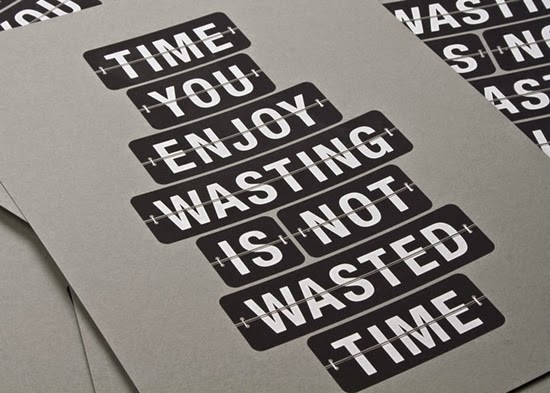
The most valuable commodity in the world is time and ironically it's the one we hold in lowest esteem. Think about all the time you've wasted over the years, all the idle hours spent watching TV, playing video games, sleeping in, and being bored.


All those hours are gone forever.

If the value of a commodity is based on supply and demand, how can anything be worth more than time?

Time is always in short supply because it's the ultimate non-renewable resource. Each one of us is born with a finite amount and life starts debiting your account the moment you're pulled from the womb. When your funds eventually run out you can't ask for an extension or borrow more time from the bank.

Things are just as bleak on the demand side of things. Nothing can be obtained, acquired, or accomplished without investing time into it, which is why everyone needs it. You've got 24 hours a day in your budget and eight of them are for sleeping. That leaves 16 hours to spend on your interests, hobbies,  education, family, friends, and peers.

How often do you hear people say, "I don't have time to do this" or "if only I had more time!" How often do you think or say these things yourself? Everyone is short on time. Everyone could use more. The only difference is that some people know it while others do not.

If you understand the preciousness of time you probably try to invest it carefully. But this begs the question: how does one go about distinguishing between worthwhile investments and worthless ones?

You need wisdom for that.

What do I mean by wisdom? Simply this: the ability to think and act using knowledge, experience, understanding, common sense, and insight, with good intentions.

Where does one acquire wisdom, exactly? It's not like there's a Wisdom 101 class being offered at your local community college. Because wisdom is actually the culmination of different skills, traits, and behaviours, it has to be assembled piece by piece. You can acquire knowledge in school or in books, experience in everyday life, understanding through study, common sense with practice, and insight through contemplation, but wisdom requires you to use them all in concert.

If only there was a one-stop shop where you could acquire the building blocks and learn to put them together... Oh wait, there is!

It's called Philosophy, which in Greek literally means "Love of Wisdom."


Forget what you think you know about philosophy. Modern academics have transformed this ancient discipline into something radically different from its original state. You need only read what ancient philosophers wrote about philosophy's purpose and function for proof. According to Seneca, for example, philosophy
is a matter not of words, but of facts. It is not pursued in order that the day may yield some amusement before it is spent, or that our leisure may be relieved of a tedium that irks us. It moulds and constructs the soul; it orders our life, guides our conduct, shows us what we should do and what we should leave undone; it sits at the helm and directs our course as we waver amid uncertainties.
You can be sure that the acquisition of wisdom, whether through philosophy or other means, is time well-spent. Wisdom dispels illusion and reveals the true worth of every object, person, pursuit, and action. It acts like a map that reveals the location of various treasures and outlines potential routes to reach them.

Wisdom reveals the hedonic treadmill beneath your feet and the endless line of carrots dangling into the distance. It gives you the ability to distinguish between worthwhile investments and worthless ones, meaning you won't waste another second of your time ever again if you don't want to.

And that's good news, considering how strapped everyone is for time.

Material pursuits are necessary. We all need to make money in order to pay the rent, stock the fridge, and obtain other bare necessities. Some luxuries are also worth pursuing, but only so long as we remember their nature and function. Luxuries are means, not ends: they make life easier, more convenient, or more enjoyable. In other words, they can contribute to the ultimate end, which I believe is the same for all people and yet so damn elusive: happiness.

A wise person enjoys material goods while they are in her possession but doesn't count on these for personal happiness. Happiness derived from externals is temporary and fleeting; it will turn to misery at Fortune's whim. A wise person spends very little time chasing temporary pleasures, choosing instead to invest time on those things that cannot be lost, stolen, or destroyed.

This life of yours is a precious and temporary gift. The sand in your hourglass is constantly slipping away grain by grain and when it runs out, that's your cue to exit stage left. It is in your power to infuse your life with purpose and meaning here and now, while you can. You have the ability to rearrange your priorities and invest every moment of your time into worthwhile pursuits.


Only a fool would choose to waste the most precious commodity in the world. Let wisdom be your map and reason your compass. With these you will never be tricked into throwing your time away.

/rant over

Friday, August 1, 2014

Mind Hack

I am an enthusiastic Darwinian, but I think Darwinism is too big a theory to be confined to the narrow context of the gene. 
- Richard Dawkins, The Selfish Gene

Memes are to the mind what genes are to the body.

While genes are molecular units of hereditary information, memes are, to paraphrase Terrence McKenna, the smallest unit of information forming a coherent idea.

Both must find hosts in order to survive, replicate, and evolve. Both are transmitted from person to person and both are subject to mutations.

Genes are the blueprints that shape the biology of our planet, from the smallest microbes to the largest dinosaurs and everything in between. Memes, on the other hand, shape the way we think and interact with each other. They are cultural and psychological DNA, the building blocks of society, technology, and belief.

Right about now you might be asking yourself, "If memes are so important, why doesn't anyone talk about them? Where are all the meme theorists? Why aren't they educating the public?"

People readily accept the existence of genes, and rightfully so; because they can be physically detected, classified, and studied, scientists have a very good understanding of the role they play in the formation and evolution of life.

Memes are immaterial. They cannot be detected by our dull senses. We can't put a meme under a microscope and say "There it is!" As a result, memetics is a neglected and oft misunderstood field of study.

The only way to study memes is to study their effect on the material world, and here we have a plethora of evidence. Memes are only invisible while they float around the memesphere. As soon as one finds its way into your mind, it becomes manifest, showing itself in a variety of ways.

Take the spear meme, for instance. The idea of a long stick with a pointy rock secured at its end was ephemeral and completely useless until our ancestor homo heidelbergensis brought the idea to life.

This is how a meme secures a spot in your mind and ensures its long-term survival. It convinces you that it will render a valuable service.

The spear meme's service is indisputable.

Spears have been humankind's go-to instrument of war and hunting for the better part of 300,000 years. Only recently has this indispensable tool been replaced by more advanced weaponry and despite this demotion, the spear maintains a hold on the public imagination. Spears are everywhere: in video games, movies, books, and TV shows.


No meme provides its service for free though; each one demands something in exchange. In addition to reserving space in your mind, some memes demand changes to your behaviour. Think of this as a downpayment of sorts: "do this, say this, and think this way, and in return I will (eventually) give you [insert reward here].

A diet plan is a great example of this kind of meme. It promises that if you (don't) eat (drink) [less/more] [calories/carbs/fat] [leafy greens/raw foods/vegetables/protein] you will get [leaner/thinner/healthier/yoked]. Notice how it works? You don't get to be yoked until you've been doing all the other stuff for an extended period of time. The diet meme requires a downpayment of discipline and faith in exchange for its potential gift.

With diets, you can gauge the results for yourself. You can track the weight you've lost or the sizes you've dropped. You know whether the meme is making good on its promise or not.

This isn't the case with all memes. Some demand a substantial downpayment and promise distant rewards that can't be measured or even detected. Some memes--let's call them con artists--survive by virtue of deception. They dupe unsuspecting hosts into believing that they will get something so amazing and valuable, it defies detection.

During the course of its evolution, the con artist has devised clever ways to exploit your most basic emotions and urges. It taps into your insecurities and feeds your ego, bypassing whatever defences you have. It's a Trojan Horse; once inside your mind, it unloads harmful and contradictory ideas that pollute your thoughts.


Love those who hate you, the con artist urges, and in the same breath: hate those who are different from you! If allowed to flourish, such memes will do great damage to your rational mind.

How should you go about defending yourself against such memes?

First, know thyself. You can't defend a fortress if you don't know its layout. Map out your inner citadel. Learn who you really are--your likes, dislikes, biases, skills, flaws, weaknesses, beliefs, and habits. Explore the myriad ways in which your mind and senses can and frequently will deceive you. Figure out how your conscious and subconscious mind interact together and how your past experiences affect your perception.

Second, master your emotions. Not all of them, mind you: just the toxic ones like hate, anger, jealousy, bitterness, self-pity, and despair. These do nothing but cloud your judgment and hinder your ability to overcome whatever obstacle has caused them to appear in the first place.

Lastly, call into question your most cherished and long-held beliefs. Examine the ideas you take for granted, the ones that knock around your mind on a regular basis. Sever your emotional connection to these memes and scrutinize them objectively.

Remember that every idea, opinion, fashion trend, technological advancement, and belief-system is just a selfish meme looking to survive. Some have valuable rewards to offer, many do not, and a select few do more harm than good.

It is your duty to appraise ideas, take them apart, examine their components, and ascertain how they work.

Only after you have done these things should you be prepared to let a meme into your inner citadel.

/rant over

Monday, March 3, 2014

Get Inside my Head

I was trying to explain meme theory to my good friend a few months back when she stated, with a dismissive eye-roll, that such topics make her head hurt. I tried to impress on her the power of ideas and the importance of understanding how they work. "Everything you see around you," I said, "is a result of human thought. Every material object, religion, political ideology, and philosophy was born in the human mind. Every human crisis and its potential solution resides in the seat of our collective consciousness. You shouldn't let the complexity of the topic discourage you from studying it."

This was her reply: "You should spend less time thinking about thinking and more time doing."

What nerve! From where do actions emanate if not from within? Where does perception of the external world arise if not in the mind?

As you read these words your brain is literally and figuratively generating the world around you: literally because everything you see around you--cars, buildings, clothes, light-bulbs, carpet, furniture, windows, space shuttles, etc.--was derived from someone's mind; and figuratively because your brain filters external stimuli and generates what you perceive today, a tiny sliver of objective reality unique unto yourself.

No one experiences the world quite the same way you do. Isn't that a trip? We're all experiencing individual, isolated realities colored by our beliefs, biases, and past experiences.

Everything is a direct or indirect result of human thought. So to my friend I say: "Maybe you should spend more time thinking about thinking and less time doing."

Your mind is divine. It is the gatekeeper, the creator, the regulator. It can make your life a blissful paradise or agonizing hell. If you don't strive to understand its inner-workings and gain mastery over it you're bound to fall prey to its devious tricks over and over again.

Human history is the stock-market of ideas: intellectual commodities rise and fall in value, compete for investors, and combine to form the various ideologies that govern human affairs. We label these mega-memes "religion," "politics," and "philosophy" but in truth they are the amalgamation of ideas, the result of colliding memes and specific socioeconomic and cultural conditions. Humans are usually involved in the making of ideologies only insofar as they carry their various building blocks.

But some people, having gained a rudimentary understanding of the rules governing the human mind, conspire to manipulate and engineer memes toward selfish purpose. They have come to the important conclusion I tried to impress upon my silly friend: that ideas regulate the material world and that the mind, being the source and carrier of both, must be understood and controlled. And so, upon understanding this, the conspirators attempt to leverage the stock-market of ideas to their benefit. They establish ideologies that facilitate the control of the masses or interpret existing ideologies to the same end.

In order to restore balance to the world and repair the many deficient social, economical, and political systems that govern our day-to-day lives, we too must accept the potency of human thought and its ability to sway events this way and that. We must learn to manufacture our own ideologies, ones that seek to reverse the current trend of exploitation and raise as the highest ideal the greater good of our species and planet.

Since the dawn of civilization the multitudes have been exploited by the select few. At first they were god-kings, then the spokesmen of the gods; later we fell under the dominion of royal bloodlines and lineages who were supposedly sanctioned by God to rule over us. (On a side note, I find it extremely disturbing that monarchs still exist, even in a solely symbolic function, and that we continue to regard them as special somehow. In many ways, this is more confusing than religion's persistent grip on the masses. But I digress.)  Finally we arrive to the present day and the various top-down democracies of the developed world, where the multitudes have very limited control over the internal conditions of their respective nation-states.

Do you see a pattern? From pharaohs and divinely-sanctioned dynasties to our current paradigm, in which an elected group of oligarchs, swayed by corporate interests, greed, and selfishness rather than the will of the voters, engage in bloodless wars of words and power-plays financed by tax-payer money.

It's progress to be sure, only not as much progress as most people think. We've traded heavy shackles for slightly lighter ones. It's a step in the right direction but our true intent should be to break free of shackles altogether.

Despite the many anchors weighing us down, we are moving forward. The will of the people cannot be stifled endlessly and the turmoil we see today in Ukraine, Venezuela, the Middle-East, and everywhere else is the proof. These are the growing pains of our species. We can move past this dark time toward brighter horizons if we get our shit together.

We'll never be rid of conflict. So long as individuals exist there will be disagreements and the butting of heads. The key is to find ways to resolve conflicts amicably, to devise a system in which everyone is free to do as they please so long as doing so does not bring about harm to others, a system bent on helping those in need, curing the sick, and protecting the weak.

The world as we know it is shrinking. We can no longer afford to see ourselves as separate from our brothers and sisters around the world. We're all passengers on spaceship earth, neighbors regardless of spiritual or political beliefs. There is enough room on earth to house all cultures, beliefs, and preferences, enough room so that all may live in peace and harmony as functional components of this great and mysterious machine. Some do not wish to see it so but they are the few; together, with our minds and our wills turned toward the highest purpose, a purpose found in all the major religions and philosophies of the world, we can veer away from our current path of over-consumption and greed toward a world of universal cooperation.

Do I think we'll succeed in forging a Utopia in our lifetime? Probably not. But for the first time in our history I believe we have the tools and knowledge to make it so. Never before have the masses been united behind a single purpose. If that purpose is universal--concerned with the well-being of humanity and the planet--I believe we could accomplish great things.

In the meanwhile, looking after the well-being of our brothers, sisters, and planet isn't a bad ideal to live by.

Monday, October 7, 2013

I Quit


There's something disheartening about discovering that your ideas are not original. I remember the first time it happened to me. As a writer I tend to build my stories around an interesting premise. What if humans had risen to prominence while the five continents were still fused together? How would the Americas have fared without European involvement? What would Tolkien's Middle-Earth look like 1,000 years after the War of the Ring? I was describing my latest idea to a friend who, after listening to me patiently, uttered these horrific words:

It's already been done. 

I consulted Google for confirmation and was crestfallen. The similarities between my premise and this novel were uncanny. I felt cheated somehow, as if this author had invaded my mind and stolen my ideas.

My first instinct was to delete everything I had written. "What a shame," I thought. It had been such a good idea. No wonder someone else beat me to it.  

Oh well. Time to start from scratch.

That was my reaction after watching John Haidt's TED Talk, "The Moral Roots of Conservatives and Liberals," found at the top of this post. In his presentation Haidt dissects some of my favorite ideas with a skill and finesse I can never hope to match. The man is highly educated, a published author who has access to resources I can only dream of.

Why bother with this blog? There are likely thousands who share some facet of my thoughts and possess the resources necessary to deliver their message to the masses. People like Richard Dawkins, John Haidt, Malcom Gladwell, Jason Silva, and Ray Kurzweil reach millions of people. What's the use in writing a blog that reaches a few dozen?

No, I'm not quitting. Quite the opposite, I'm just getting warmed up.


There are few if any truly original ideas left out there. What we think of as new ideas are actually modifications of old ones. Take fantasy as a literary genre, for example. Even as a kid I noticed the stereotypes: brave knights, fire-breathing dragons, evil sorcerers, wise old wizards,  immortal elves, surly dwarves, green-skinned orcs--the list goes on.  Without Tolkien, very few people would know anything about magical rings, treasure-hoarding dragons, or heroic quests. The similarities between Tolkien's epic trilogy and every other fantasy book published since are far from coincidental. Authors fully welcome Tolkien's influence on their works. For a long time, these post-Tolkien authors made no effort to differentiate themselves from the man who inspired them.

Eventually, variations started to pop up. These variations--successful mutations of the fantasy gene, if you will--accumulated. Sub-genres like dark fantasy, sword-and-sandal, steampunk, and urban fantasy emerged. What better way to illustrate the evolution of ideas than to compare Lord of the Rings to, say, Game of Thrones?

Here is yet more convincing evidence in favor of meme theory. Tiny little modifications are made to existing ideas. Most are worthless but few prove valuable. Over time these worthwhile modifications add up and we find ourselves with a radically different idea than we started with. Remember, these are just shapeless notions manifested into reality by human ingenuity. Oh, the marvels!

As for the Meme Merchant, I'll stay the course. If I can contribute to the evolutionary process of ideas and maybe help a few people look at life differently along the way, I think that's valuable in itself. With your help, maybe I can pull together several ideas together and form something better than the sum of its parts. Not a new idea but an amalgamation of existing ideas. Sort of like when the Power Rangers combine their dino-bots into a gigantic, ultra-powerful mega-robot.
It's a MEGAZORD, for petesake!

Only cooler.

(PS. Even Tolkien's ideas were borrowed from the lore and mythology of the Norsemen. Furthermore, Richard Wagner wrote an epic opera about a ring so powerful it could rule the world in 1874. That's 63 years before Tolkien penned the Hobbit! Tolkien never denied Norse mythology's influence on his works; quite the opposite, he openly admitted taking many of his ideas from their pages.The lesson? It's not plagiarism if you tweak the details! /rant over)

Wednesday, October 2, 2013

The Intellectual Commodity--Part III


As of now we’ve established the importance of ideas as the building blocks of human works great and small. Their intrinsic value and effect on material commodities cannot be denied, nor can we deny that the marketplace of ideas is over-saturated. If information, knowledge, and ideas are crucial to human existence, and we are today overcome by a tidal-wave of data, how can we identify the good ideas from the bad?

Skepticism is crucial for qualifying conflicting ideas. Think of skepticism as putting an idea on trial. You would never expect a prosecuting attorney to build his entire case around the testimony of the accused and nothing else, would you? 

Think back to our crash-course on meme theory. Ideas survive, adapt, and replicate not because they are more valid than others but because they are good at surviving, adapting, and replicating. If we study an idea by itself we are not likely to obtain a fair assessment of the facts since its sole purpose is survival and replication. Just like a criminal facing capital punishment, ideas do and say what they must to continue existing. That is why good attorneys call a long list of people to the stand, from character-witnesses and eye-witnesses to experts in relevant fields. Each witness brings something new to the table.
In your mind's courtroom, you play the role of prosecutor, defense-attorney, and jury. As a result of
Try not to let the trial turn into this.
this amalgamation of roles, your job is neither to prove nor disprove the idea but rather to determine its validity toward your life. In 700 CE, Jianzhi Sengcan said: "If you want the truth to stand clear before you, never be for or against.The struggle between 'for' and 'against' is the mind's worse disease." To successfully rid yourself of "for" and "against," you must first dissolve your ego. Take your pride and remove it from the equation. Approach the question with a completely open mind. 

Next, call your witnesses to the stand. The more the better. News articles, books, Wikipedia, documentaries, message-boards, personal experience. These testimonies will form the backbone of your decision, but only if you filter them through a final--and crucial--filter.
From a paper detailing the "Cigarette Controversy," published in 2007:

"In 1994, heads of the major U.S. tobacco companies testified before Congress that the evidence that cigarette smoking caused diseases such as cancer and heart disease was inconclusive, that cigarettes were not addictive, and that they did not market to children. Less than 1 month after this testimony, a box containing confidential documents from the Brown & Williamson Tobacco Corporation was delivered to the University of California at San Francisco. What was revealed in these documents was evidence that the tobacco industry had for decades known and accepted the fact that cigarettes caused premature death, considered tobacco to be addictive, and that their programs to support scientific research on smoking and health had been a sham (
1-6)."

To recap: for decades, tobacco companies lied about the effects of their products and continued to sell cigarettes despite knowing that they caused a wide-range of health problems. The pertinent part here is that they hid this data, either buying the silence of independent researchers or funding their own pseudo-scientific studies to "prove" the safety of cigarettes. 

There is a costly lesson to be learned here. Knowing the source of the information is just as important as the information itself.

By qualifying the source of your information, you put the information into context. Would you take financial advice from a friend who is in enormous debt? Marriage advice from a life-long bachelor? Parenting advice from a childless aunt? You shouldn't discard it outright--after all, even a broken clock is right twice a day--but you would probably take such advice with a grain of salt.

Likewise, you should be vigilant when perusing the marketplace of ideas. Learn about your sources. Be on the lookout for conflicts of interest. Remember that people perceive reality through their own subjective lens, their views likely different from yours in some ways. Remember also that some people stand to gain or lose from the acceptance of certain ideas. Like the tobacco industry, these ones may resort to foul play in order to convince the unsuspecting. 

When you read an article like this, don't boycott TED and decry the organization as unreliable. Your broke friend might not know much about finances but maybe he has other wisdom to offer. Maybe he's great with the ladies or awesome at golf. Get to know your sources: only then can you truly assess the validity of their claims. TED Talks are still a valuable source of information, so long as the topic doesn't involve GMO's, food-as-medicine, or "pseudoscience." Any claims they make with regards to these topics should be immediately met with extreme skepticism. Otherwise, continue to exercise normal caution and you should be fine.
Smug bastard. Totally thinks he's better than me

In closing, I should note that most ideas are neither objectively good nor bad. In some ways ideas behave like stocks, their values rising and falling with the changing times. An idea's worth varies from person to person. Take divine rule, for example. The idea that a deity has chosen pharaoh Suchandsuch to rule Egypt benefits the pharaoh a great deal. 

The rest of Egypt? Not so much.  


Saturday, September 28, 2013

The Intellectual Commodity--Part II

In part I of this series I attempted to convince you that ideas should be regarded as intellectual commodities no less crucial to the global economy and our everyday lives than material commodities.

To summarize: information, ideas, and knowledge are no different from material commodities. They can be bought, sold, and traded. Those privy to certain valuable knowledge--how to build a fire was the example I used extensively in part I--have, over the course of human history, enjoyed positions of influence, power, and prestige. Furthermore, the value of material commodities such as gold, crude oil, wheat, etc. is largely dependent on knowledge. In ancient times, oil was used only in the making of pitch and asphalt; as such, its value was much lower than it is in today's world. You may attribute this to supply and demand--after all, nearly every human in the developed world depends on oil in one way or another--but this increase in demand is a direct result of scientific discovery.

Without knowledge of combustion, the demand--and value--of fossil fuels dwindles. Likewise for precious metals without knowledge of metallurgy. These are simplistic examples but no less valid. Extrapolate them as you like and you will find the same results.

Without knowledge, there is no demand.

The importance of ideas does not end with their effect on the price of commodities.

Look around you. If you're sitting in your home, chances are you see some furniture, appliances, electronic devices, clothing, dishes, etc. Beyond your possessions you may also notice walls, light-fixtures, carpet, and so on. Brace yourself: everyone of these things was born inside a human mind. The material objects in your life were literally manifested into being from the minds of their creators.


Even when ideas do not manifest themselves in the material world they can still have a significant impact on our lives. The concepts that dictate much of our behaviour--social norms, marriage, employment, laws, government--were not only born inside human minds, they also spend most of their time living there. The concept of family, for example, forms invisible bonds between partners and their children. The concept of employment creates similar bonds (though some might call them shackles) between workers and employers. Remember: these are all ideas, vague notions of how we ought to behave towards and treat the different people in our lives.

Again, the immaterial drives the material.

The importance of ideas cannot be overstated. They are the source of all human works and the glue that holds the great human organism together.

Which brings us to the world we live in today. Humanity's access to information is unprecedented. The advent of the Internet, along with wireless reception, smart-phones, tablets, and lap-top computers, has brought the wealth of human information to our fingertips. The Internet stands at the heart of this techno-information revolution. It is a powerful tool for humanity but it is not without fault. Its greatest strength--widespread access to information, a ready audience for anyone with a voice and Internet connection--is also a glaring weakness.

Everywhere we look we are assaulted with information. No sense-organ is left unmolested.

Finding factual information inside the hive-mind can be challenging. With so many ideas floating around, so many conflicting opinions and views, how can we be sure we are getting the truth? Is there even such thing as objective Truth with a capital "T"? Furthermore, how can we avoid being duped by charlatans and other unscrupulous types looking to purposely mislead us?

Imagine a friend tells you about an article he read recently. "Cigarettes," this friend proclaims, "are actually good for you! Scientists at the University of Kentucky ran a double-blind study proving that the negative effects of tobacco have been grossly exaggerated. They even discovered several benefits to tobacco!"

"But cigarettes are bad," you might reply. "Everyone knows that!"

But how does "everyone know that?" How do we know this information hasn't been falsified for nefarious reasons? What if cigarettes are actually quite good for your health and physicians, seeing that they would be out of business if word got out, banded together to form the most successful smear-job of all time?

Let's face it: none of us have actually conducted research on this matter firsthand. Chances are none of us have even read a single peer-reviewed paper on the topic. We trust secondhand accounts. We trust journalists--experts in communication--to take medical jargon and produce a concise, comprehensible, and honest summary.

Unfortunately journalists are neither scientists nor physicians. Some journalists specialize in particular fields but this does not replace years of medical or scientific training. Journalists also happen to work for capitalist enterprises. Media conglomerates depend on the sensational to sell copies. They also depend on the financial support of other capitalist enterprises in the form of advertisement. What might these media conglomerates do to sell more copies or please certain financiers? Might they falsify the facts, tweak them to make a more captivating headline? Or perhaps they could ignore certain events or topics altogether, or put more emphasis on trivial matters like celebrity gossip.

Okay, I'm not really arguing that cigarettes are good for us or that we've been lied to for decades. With regards to cigarettes, I believe the data is factual. I say "believe" because that is all any of us can ever do.Whenever we express a point of view--that certain commodities will go up in value, that certain diets will make you skinny, that certain ideologies will lead to everlasting life--we are exercising faith, that is belief lacking concrete evidence.

It may sound strange to profess "belief" or "faith" in scientific research; after all, isn't the whole point of the scientific method to eliminate guess-work? To reiterate: unless you personally conducted the experiment and penned the paper yourself, you are exercising faith, not in a deity or supernatural being but in second-hand testimony.

You put your faith in Fox News because, by God, they're unbiased.

The most ardent supporter of the scientific method is indistinguishable from the young-earth creationist. Both exercise faith; only the object of said faith differs.

Disclosure: I am not promoting a purely agnostic stance. I am not suggesting that we live our lives in perpetual uncertainty, unsure of even the most basic truths. What I am proposing is that we exercise caution when faced with conflicting ideas; that we not take one side or another at face value; and that we employ multiple standards of proof when absorbing any piece of information into one's collection.

Standards of proof are like scales that weigh the validity or truth of any given piece of information. There's a ton of them out there and, to confuse matters even further, different people employ (and value) different ones.
Justice may be blind but you don't have to be

Some people put their trust in the scientific method while others refer to personal or anecdotal experience. Many rely on the testimony of spiritual, political, or philosophical leaders. Atheists, for example, love to quote Hitchens and Dawkins while theists tend to quote scripture. "Science proves there is no God!" the atheists cry, frothing at the mouth. "God made science so he doesn't have to follow its rules!" theists counter.

Fear the person who claims to be 100% certain of anything. If history has taught us anything it is that we are more often wrong than right; that our understanding of ourselves, the planet we live on, and the universe that surrounds us comes in small, progressive steps; and that, with each progressive step, human understanding of reality is refined, always driving towards that elusive goal of objective Truth.

Sound familiar? It ought to. This long-term refining process fuels the universe and everything in it. We humans are just one of its many byproducts.

Next week we'll get to my favourite standard of proof: qualifying the source. How can we truly know the validity of information if we do not scrutinize the source of said information first?

(PS. This series on the Intellectual Commodity was actually supposed to be one post but it just kept growing. Now I'm fairly confident I will get it done in three. I like to go on tangents, in case you hadn't noticed. It's quite difficult to tackle metaphysical topics without straying a bit. Hope you guys are getting a mental workout because I know I am! /rant over)


Wednesday, September 25, 2013

The Intellectual Commodity, Part I

People have no problem understanding the importance of commodities. These marketable items form the backbone and driving force of the global economy. They also play a crucial role in our everyday lives. Imagine waking up to find our planet's supply of oil suddenly expired. How might your life be affected by this? How about the world at large? This is a matter of pure speculation, of course, but our reliance on oil is no secret. What would happen if the pumps went dry?

Hello, dark age, my old friend.

It's safe to say that our lives depend on the availability and affordability of many commodities. What many fail to realize is that information is also a commodity. Like oil, copper, rice, wheat, iron, gold, silver, etc. information can be bought, sold, and traded. Furthermore, the value of material commodities is intrinsically tied to knowledge. The two enjoy a symbiotic relationship, depending on each other in many ways. But more on that later.

Early humans knew the value of information and went to great lengths to preserve it. They invented written-languages and methods to preserve such writings. From baked-clay tablets to papyrus scrolls to paper, it's no surprise that with each improvement comes similar progress in other disciplines. Our ability to store, access, and share information is directly correlated to our overall prosperity.

Let us examine the tale of Prometheus for an interesting angle on the value of ideas. According to the legend, the greek god Prometheus, creator and biggest supporter of humans, steals the secret of fire from his fellow Olympians and delivers it to our kind, signalling the dawn of civilization. For his troubles, Prometheus is sentenced to an eternity of torture. Tied to a stone, he is doomed to have his liver eaten by an eagle (Zeus' pet) every day, only to have the pesky organ regrow every night.
I'd be sad too if my liver was getting eaten by an eagle :(

Surely this isn't how it really happened. The secret of fire was probably stumbled upon by some stone-age hunter. Isn't it telling though that later generations attributed the discovery to a god? This piece of information was so valuable, so pivotal to our survival and expansion, that our ancestors could not fathom it originating within humanity.

Perhaps the legend of Prometheus was inspired by some older oral tradition. Perhaps the tribespeople who bore witness to this momentous event deified the person responsible. Certainly the first artisans, shamans, and mid-wives enjoyed similar privilege and status among their people. Likewise for the first shepherds, shipwrights, and farmers. It is no accident that ancient humans assigned gods to oversee every trade. The old pantheons are packed with gods that represent blacksmiths, farmers, warriors, shepherds, prostitutes, and so on. Isn't it odd that, though these roles are all human inventions, later generations attributed their origins to gods?

New inventions to explain old inventions. Marvel at the human mind, ye mortals!

Let us continue with the example of fire. Before they mastered the creation of fire, our ancestors depended on chance for finding it in the wild. Once obtained, tribes worked to preserve the sacred flames. If the embers went out, these tribes were plunged into darkness and their lives became much more difficult. To them, fire could be a matter of life and death.

Imagine now the first few people who, through blind luck or careful observation, discovered ways to make fire without the aid of lightning. It's no wonder the lucky person who first succeeded at making fire was deified! Initially the process of starting a fire would have been imperfect at best. The rate of success would have been very low but that didn't matter. All it took was a single successful attempt to get the ball rolling.

Over the centuries the process for making fire was refined. New methods or techniques were discovered. Some improved success rates, others did not. If you read my previous post, you know what happens next: changes that improve the process are kept and reenforced; changes that hurt the process are discarded and go extinct. When you go camping, you don't make sacrifices to the fire-god or perform ritualistic dances before making a fire.

That's meme theory hard at work.

Prehistoric humans were just that: pre-historic. They had no means of looking back in time, no way to trace their own progress across the ages. It was impossible for our ancestors to fathom the millennia-long process of refinement described above. The art of making fire had come to them complete, a finely-tuned science far too miraculous to have been born of human thought. The story of that first fire-starter, like the process of making fire itself, would have been refined with each generation as well. Over time, the inventor of human-made fire became something more than human.

And that's how gods are made, kids.

Biological evolution, by the way, works in much the same way. Tiny mutations appear over the span of millions of years, some surviving and multiplying, others dying out; the survivors piggy-back on top one another, creating increasingly more complex organisms. The end result, finely-tuned over a sprawling chasm of time, barely resembles the starting product. Ironically, this phenomenon drives many people to an eerily familiar conclusion. Glimpsing the end-product, they cannot fathom the long process of refinement that led to it and attribute our existence--and the existence of the entire universe--to divine design*.

Despite all the progress we've made as a species, we're not terribly far from where we started.

But I digress. 

The value of information as an intellectual commodity cannot be overstated. Without knowledge of combustion, the value of crude oil would be greatly reduced. Without knowledge of metallurgy, the value of copper, iron, silver, and gold might be nonexistent. Seeds are worthless in the hands of those who don't know how to sow them and nurture them to adulthood. This is the symbiotic relationship I alluded to earlier. Material commodities depend on intellectual commodities--knowledge, information, ideas--for their value. Without knowledge, even gold is worthless.

If ideas are commodities then we're bound to meet people who stand to gain or lose from their acceptance or rejection. Next week we'll discuss the importance of validating information, standards of proof, and how to make educated decisions in the face of conflicting testimonies.

/rant over.

*Interestingly, this thought-process creates an unsolvable problem. If we argue that something complex must have a creator, we agree that the creator must be more complex than the thing created. By that logic, God must be more complex than all he created. Following this premise, we must agree that God, being more complex than the universe itself, could not have come to being by accident or on His own. Therefore, God must have a creator, and that creator, being more complex than God, must also have a creator. SO ON AND SO FORTH AND SUCH. /rant over again.

Thursday, September 19, 2013

What is a Meme?

Most people think that memes are photos with clever captions but in reality, the concept predates "Success Kid" and "Forever Alone" by several decades.

The term "meme" was coined in 1976 by evolutionary biologist Richard Dawkins in his book "The Selfish Gene."

My trusty friend Wikipedia defines a meme as
an idea, behaviour, or style that spreads from person to person within a culture. A meme acts as a unit for carrying ideas, symbols, or practices that can be transmitted from one mind to another through writing, speech, gestures, rituals, or other imitable phenomena. Supporters of the concept regard memes as cultural analogues to genes in that they self-replicate, mutate, and respond to selective pressures.

So damn clever

The implications of meme theory can be a little bit disturbing.

As writer/documentarian Jonnie Hughes puts it:
If ideas are just like living things, then they are subject to Darwinian rules – inherently selfish entities, doing anything and everything they must to survive and propagate. And in this scenario, what are we? Little more than their hosts, their habitats? Vehicles to carry them from one parasitic generation to the next, coerced accomplices to their wild ambitions? If this idea has any substance at all, it will upset a lot of people.

Put succinctly, the question goes like this: do human minds spawn ideas or do they simply carry and spread ideas onward? Do we have a choice in the matter or are we the unwitting hosts of selfish ideas?

I should think the answer, as is often the case with binary questions, is both.

We birthed the first memes in our minds, as a reaction to various forms of stimuli; but once they came into existence, they took on lives of their own and became subject to the law of natural selection.

Some memes, reinforced by successful mutations, thrive and spread out while others turn out to be memetic dead-ends.

And as for the matter of choice, it seems clear that we can, under certain circumstances, choose to cast certain ideas or beliefs out of our minds. More often than not, however, we seem to be unaware of the memes we carry within ourselves.

If you want to find proof that meme theory is legitimate, you need only study the fossil record of human ideas.

Why don't we worship Zeus, Odin, or Ishtar anymore?

Why aren't modern nations governed by God-Kings?

What happened to the feudal system?

These questions may sound silly to modern humans, and rightfully so. We ride metallic tubes across the skies, communicate with each other via invisible signals, and beam the wealth of human knowledge across thin air to hand-held super-computers.

Armed with the scientific method, modern humans have laid waste to many long-held myths. We know that the Mesopotamian, Greek, Roman, and Nordic pantheons are fictional, the product of human curiosity and imagination. We know that kings are just regular people, not divine representatives. We know that the feudal system was little more than organized slavery set up by greedy aristocrats.

To us, these memes are barely worth considering. But to someone living in the ancient world, they were fact. Countless people lived and died according to the whims of these now-extinct memes.

Memes evolve with our understanding of the universe.

From polytheism to monotheism; from slavery to Emancipation; from despotism to modern democracy: trace our progress from pre-history onward and you'll see the forward march of memetic evolution, punctuated here and there by a backward step (or three).

The role of memes in our ongoing evolution cannot be overstated: they drove our species from a ruthless nomadic existence to the relative safety of sedentary civilization, gave rise to countless technological wonders, and refined our understanding of reality.

Whether good or bad, memes are no small matter.

Which brings us to our second question: why name my blog the "Meme Merchant?"

In my first post, I tried to illustrate the importance of curiosity in finding peace and happiness. I likened it to a journey and I am all too familiar with the difficulty of those first steps. With so much information out there--so many selfish memes actively seeking to replicate--it isn't easy to find the kindling that will light your curiosity aflame.

This then is my mandate.

To sift through the trash bins and galleries of human history; to scour the minds of great thinkers past and present; to explore unorthodox ideas; and finally, to share my findings with you.

I'll focus on the memes that kick-started my curiosity, memes that offer practical advice, incite awe, or promote self-inquiry.

I won't shy away from memes exhibiting backward-thinking and irrationality, either. After all, even bad ideas have value, if only in teaching us what not to think!


Memes are all around us. They form the invisible glue that holds humanity together. No topic is taboo, no opinion or idea--no matter how irrational or emotionally-driven--is worthless.

Welcome to the Meme Merchant.

PS: For more on meme theory, here's a great TED Talk by Susan Blackmore. Sums it up very nicely.

Tuesday, September 10, 2013

Consult Your Physician

You know when you feel the weight of sadness. You're exhausted, hopeless, anxious, or bored. No matter what you do or accomplish, you feel lonely and hollow. You're perpetually hunting down a better job, a better partner, more money, and bigger toys, but nothing fills the void in your heart.

You don't enjoy the things you once loved. Things just don't feel the same. 

These are some of the symptoms of adulthood, a serious medical condition that is on pace to affect 7 billion people worldwide. Researchers have proven that 100% of children who survive childhood will develop full-blown adulthood, a chilling fact when one examines the symptoms listed above.

What is adulthood? Biologically speaking it is marked by the onset of puberty and the ability to reproduce. Thankfully our society realizes that puberty is an inadequate marker of one's autonomy. One must learn a great deal in order to navigate the intricacies and pitfalls of this world, so much in fact that it is nearly impossible for a child to adequately prepare for the inevitable onset of adulthood.

For this reason, most developed nations set a second marker--legal adulthood--located between 18-21 depending on where you live. This second milestone is accompanied by the ability to enter legal contracts, vote, and consume regulated substances such as tobacco and alcohol. Legal adulthood is also typically accompanied by independence from one's parents and the financial burdens that come with such independence.

As a young adults you were sent out into this complex world and tasked with making the best decisions possible, not only for yourself but also for those connected to you, your friends, lovers, business partners, co-workers, parents, children, not to mention the thousands of strangers surrounding you at any given time.

Were you sufficiently prepared for such responsibilities? I know I wasn't.

Parents, teachers, and peers teach to "do good" but what does that mean, exactly? My definition of a good life probably varies from yours, as it should. Travel to another country--one that is less developed, more conservative, less free-thinking, etc.--and we find yet another definition for the good life. How can one not feel overwhelmed when loosed into the "real world," equipped only with the tools provided by a mediocre education and your parents?

The bulk of one's adult life is spent doing mundane tasks--working jobs that do not inspire, obtaining education that teaches nothing, performing chores that incite dread at the mere thought of them. Is it any wonder that sleep, an activity that entails literally doing nothing (and was often associated with death by ancient humans), has become a favorite pass-time of the masses? Those struggling with adulthood will often wake up after a full-night's sleep feeling exhausted and dreading the day ahead.

If this accurately describes your life--if you prefer the nothingness of sleep to the wonders of the universe--then prescription Curiosity might be for you.

Curiosity is not a drug, nor does it reverse the negative side-effects of adulthood. Side-effects of Curiosity are euphoria, revelation, and awe--all natural cures for boredom, emptiness, and depression.

Always feel tired? Think there's no purpose to life? Maybe you believe the world is going to shit all around us. Maybe you think human nature is to blame, that people are inherently selfish, cruel, and ignorant. Do you hate your job? Your co-workers? Do you always fight with your spouse? Are you incapable of making meaningful connections? Do you constantly blame circumstances or other people for your troubles? Do you believe you're destined to die alone, a complete and utter failure?

Whatever your problems, the solution starts with Curiosity but it certainly doesn't end there.

Prescription Curiosity will lead you to novel ideas and new ways of seeing the world. Once awakened to the awesomeness of the universe, the symptoms of adulthood will abate. You will find peace and tranquility. Every revelation brought forth by curiosity will lead to innumerable others. The hidden paths are made visible by Curiosity, and they lead to strange and wonderful places!

So what are you waiting for? Take your first dose of Curiosity and see where it takes you! Indulge every curious thought. Seek answers to every question that creeps into your mind. Follow your interests, your passions, then seek out their siblings and branch out further. Who knows where Curiosity will take you? One thing is certain: it can't be worse than going through life unhappy and unfulfilled. 

DISCLAIMER: If you have been inoculated with religion, do not take Curiosity without first consulting your priest, pastor, or spiritual custodian. Only take Curiosity if you have an open-mind, otherwise you could experience mild side-effects ranging from irritation to complete self-deception. If Curiosity is leading you to disturbing destinations you may want to consult your therapist. Keep Curiosity out of the reach from cats.