Showing posts with label Behavior. Show all posts

Friday, September 19, 2014

Beginning of Salvation

You must discover yourself in the wrong before you can reform yourself. Some boast of their faults. Do you think that the man has any thoughts of mending his ways who counts over his vices as if they were virtues? Therefore, as far as possible, prove yourself guilty, hunt up charges against yourself; play the part, first of accuser, then of judge, last of intercessor. At times, be harsh with yourself.
-- Seneca the Younger
What happens when you suddenly realize that you were wrong, rude, stubborn, mean, ignorant, irrational, insensitive, or careless? Do you acknowledge your mistakes and resolve never to repeat them or do you deny their very existence? Do you yank the weeds out of your garden or allow them to choke out the flowers?


"The knowledge of sin," said the philosopher Epicurus, "is the beginning of salvation." At least it should be. For most people, the knowledge of sin is nothing more than an opportunity to practice denial and willful ignorance.

You'd think we would be relieved to discover our flaws. How is anyone supposed to improve if they never discover where they need improvement? How is anyone supposed to grow if they ignore every opportunity to do so?

The answer is simple: they're not.

Few deny that self-improvement is a worthwhile pursuit. No one wants to get worse at something. No one wants to go backward in life. Whether you're an athlete, parent, artist, carpenter, nurse, or salesperson, you should want to be the best--not the best in the world necessarily, nor even the best in your league, but rather the best you can be. In other words, you should want to reach your full potential. You should strive for excellence in everything you do, not to showboat or prove yourself better than others but because that's what you were made to do.

One way to be the best version of yourself is to build on the skills and positive qualities you already possess. People tend to have less difficulty walking this path. They understand that practice makes perfect, that hard work leads to results, so they train, study, and put in the hours.

But that's only half the job, and arguably, it's the least important half. No matter how hard you practice, no matter how good you get, your flaws and weaknesses will always hold you back.


Instead of focusing on what you can do better, why not figure out what you should stop doing? In case you haven't figured it out yet, we're back in "Know Thyself" territory here. In order to be excellent, you have to be ready to discover some unpleasant things about yourself.

I told my good friend this very thing and her reply was very insightful. She said, "I've been there before and I don't like the feeling. I don't like being exposed without my armor." What she calls her armor is actually her Ego, who fights off any and all uncomfortable revelations that come with authentic knowledge of self. What my friend doesn't know is that the skin beneath her "armor" offers more protection than the Ego ever will.

In fact, the Ego doesn't protect her at all: it protects itself. My friend just so happens to mistakenly identify the Ego as her authentic Self.

There's nothing like realizing that you've been a giant douche-bag for the majority of your life, especially if you spent those years believing you were a witty, charismatic, likable character. I'm not speaking generically here, folks. I'm talking from personal experience. When I write about knowing yourself and being mindful, I'm not preaching from on high. I'm in the trenches with you, my friends.

It's an ongoing and never-ending process.

Every night before bed, I reflect on the day's events like a detective investigating some petty criminal. I look for moments of selfishness, ignorance, insensitivity, and irrationality. Without fault, the process always uncovers some new flaw or questionable habit.

Face, meet palm.
The sting you feel in these situations is an unnecessary reaction. Unless you were being an asshole on purpose, why would you feel guilty? You were blissfully unaware of your moronic behavior. Now that you're aware of it, you can amend it.

These little revelations should bring relief, not shame or embarrassment. Each one is a lesson. Learn it and reduce your chances of backsliding. Do this over and over again. Yank the weeds out the moment they break ground and eventually they'll all but stop growing. You'll look back at the person you were a year ago with a mixture of wonder and relief.

You won't be a different person. To the contrary, you'll be more you than you've ever been. The authentic You--the reasonable, creative, loving You--will flourish. All the petty grievances, worries, grudges, and judgments are holding you back. Drop them and move on. You'll be thankful you did. 

Anyway, I had a nice little moment of douche-baggery at work just the other day. I belittled someone and dismissed their concerns without knowing it. I probably would've remained unaware too if it wasn't for my co-worker who just happened to overhear the exchange.

Now most of the time people don't tell you when you're being a jerk, or else they tell you in the worst possible way. Not my colleague. She very clearly, directly, and respectfully told me that I was being an asshole. I tried to justify my behavior. She listened and stated flat out that I was wrong.

I went back to my desk and mulled it over. Of course my colleague was right. I had been insensitive, inattentive, and dismissive. That wasn't my intention, of course, but it was the end product nonetheless. So I apologized to the person I had mistreated and when I ran into the colleague who had pointed out my thoughtless behavior, I thanked her too.

"What for?" she asked. I explained to her that she had been right--I had been an asshole--and that I probably wouldn't have realized it without her.

She was flabbergasted. "Most people have a hard time admitting that kind of stuff," she said.

Which is both true and a shame. We're all capable of self-awareness. We're all capable of dissolving the Ego and being free of psychological constraints. Like anything else, it takes practice and dedication.  It means stepping out of your comfort zone and exposing yourself to sometimes scary and often uncomfortable truths.

The payoff, though, is well worth it. It's nothing short of freedom--freedom from insecurity, aimlessness, and discomfort. You become at home in your body and mind.

You become you, which is the first and most important step to finding true, lasting Happiness.

/rant over 

Monday, September 15, 2014

Hot Commodities

It is not that we have so little time but that we lose so much. The life we receive is not short but we make it so; we are not ill provided but use what we have wastefully.

--Lucius Seneca, On the Shortness of Life

What is the most valuable commodity in the world?

Is it Gold?

Water?

Rice?

Coffee?

The correct answer is, None of the above.

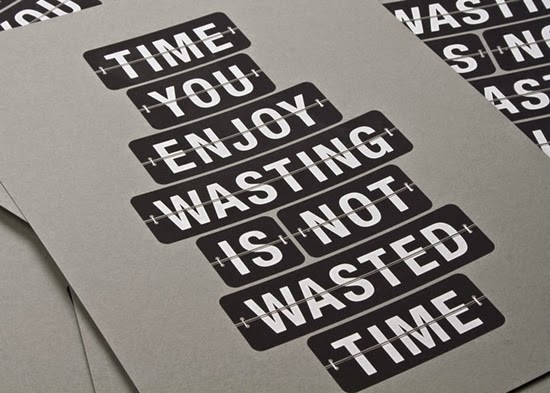
The most valuable commodity in the world is time and ironically it's the one we hold in lowest esteem. Think about all the time you've wasted over the years, all the idle hours spent watching TV, playing video games, sleeping in, and being bored.


All those hours are gone forever.

If the value of a commodity is based on supply and demand, how can anything be worth more than time?

Time is always in short supply because it's the ultimate non-renewable resource. Each one of us is born with a finite amount and life starts debiting your account the moment you're pulled from the womb. When your funds eventually run out you can't ask for an extension or borrow more time from the bank.

Things are just as bleak on the demand side of things. Nothing can be obtained, acquired, or accomplished without investing time into it, which is why everyone needs it. You've got 24 hours a day in your budget and eight of them are for sleeping. That leaves 16 hours to spend on your interests, hobbies,  education, family, friends, and peers.

How often do you hear people say, "I don't have time to do this" or "if only I had more time!" How often do you think or say these things yourself? Everyone is short on time. Everyone could use more. The only difference is that some people know it while others do not.

If you understand the preciousness of time you probably try to invest it carefully. But this begs the question: how does one go about distinguishing between worthwhile investments and worthless ones?

You need wisdom for that.

What do I mean by wisdom? Simply this: the ability to think and act using knowledge, experience, understanding, common sense, and insight, with good intentions.

Where does one acquire wisdom, exactly? It's not like there's a Wisdom 101 class being offered at your local community college. Because wisdom is actually the culmination of different skills, traits, and behaviours, it has to be assembled piece by piece. You can acquire knowledge in school or in books, experience in everyday life, understanding through study, common sense with practice, and insight through contemplation, but wisdom requires you to use them all in concert.

If only there was a one-stop shop where you could acquire the building blocks and learn to put them together... Oh wait, there is!

It's called Philosophy, which in Greek literally means "Love of Wisdom."


Forget what you think you know about philosophy. Modern academics have transformed this ancient discipline into something radically different from its original state. You need only read what ancient philosophers wrote about philosophy's purpose and function for proof. According to Seneca, for example, philosophy
is a matter not of words, but of facts. It is not pursued in order that the day may yield some amusement before it is spent, or that our leisure may be relieved of a tedium that irks us. It moulds and constructs the soul; it orders our life, guides our conduct, shows us what we should do and what we should leave undone; it sits at the helm and directs our course as we waver amid uncertainties.
You can be sure that the acquisition of wisdom, whether through philosophy or other means, is time well-spent. Wisdom dispels illusion and reveals the true worth of every object, person, pursuit, and action. It acts like a map that reveals the location of various treasures and outlines potential routes to reach them.

Wisdom reveals the hedonic treadmill beneath your feet and the endless line of carrots dangling into the distance. It gives you the ability to distinguish between worthwhile investments and worthless ones, meaning you won't waste another second of your time ever again if you don't want to.

And that's good news, considering how strapped everyone is for time.

Material pursuits are necessary. We all need to make money in order to pay the rent, stock the fridge, and obtain other bare necessities. Some luxuries are also worth pursuing, but only so long as we remember their nature and function. Luxuries are means, not ends: they make life easier, more convenient, or more enjoyable. In other words, they can contribute to the ultimate end, which I believe is the same for all people and yet so damn elusive: happiness.

A wise person enjoys material goods while they are in her possession but doesn't count on these for personal happiness. Happiness derived from externals is temporary and fleeting; it will turn to misery at Fortune's whim. A wise person spends very little time chasing temporary pleasures, choosing instead to invest time on those things that cannot be lost, stolen, or destroyed.

This life of yours is a precious and temporary gift. The sand in your hourglass is constantly slipping away grain by grain and when it runs out, that's your cue to exit stage left. It is in your power to infuse your life with purpose and meaning here and now, while you can. You have the ability to rearrange your priorities and invest every moment of your time into worthwhile pursuits.


Only a fool would choose to waste the most precious commodity in the world. Let wisdom be your map and reason your compass. With these you will never be tricked into throwing your time away.

/rant over

Tuesday, August 12, 2014

Mantra

Whenever you feel anxious, worried, inadequate, helpless, or overwhelmed, let this be your mantra: to make the best out of every situation and do the best you can with what you're given.

Repeat your mantra. Let it be your prayer, your incantation, your spell of protection.

Nothing else matters. Everything else is superfluous. Here's why.

The things in your life can be divided into three categories: the stuff that's completely outside of your control, the stuff that's partially in your control, and the stuff that's entirely in your control.

If an asteroid slams into the earth right now, for example, that's out of your control. Likewise, if a tornado comes screaming through your neighborhood, or if an earthquake brings your house down on your head, or if the global economy crashes, you can't do anything to stop it.


99.999999% of the universe is unknown and the .000001% we know about is mostly random chaos. Don't waste energy worrying about what might happen, or what has already happened. Instead, recite your line: do your best with what you're given.

People around the world experience natural disaster, war, poverty, and disease on a daily basis. How do they deal with such hardships? They mourn. They endure. They pick up the pieces. They march through horror, oppression, and atrocity. But more importantly, they persevere.

They do their best with what the universe has given them, even when what they've been given sucks. Some people get dealt a terrible hand right off the start. Others never get to play their cards because some warlord comes in and butchers their entire family or a tsunami sweeps everyone they knew into the sea.

Did these people worry beforehand? Would it matter if they did? No. What matters is that bad stuff went down and they dealt with the situation as best they could.

Now some things can be harnessed but not fully controlled. They can be tamed, sometimes briefly, sometimes barely, and be made to work for you. These things are fleeting and fickle. They are never completely secure in your grasp, so if you start to depend on them for a sense of self or happiness, you're definitely going to be bummed out sooner or later.

If you apply for a job, for example, you can partially control the outcome. Your appearance, mannerisms, and words can all contribute to your getting the gig. You have control over those things.

The person interviewing you, on the other hand, is a wildcard. You cannot predict with any real accuracy how they will perceive you. Certainly dressing the part and being prepared are good ways to stack the deck in your favor, but what if you remind your future boss of someone they despise? What if you make an offhand comment that somehow offends them? What if they don't like your cultural background, belief system, way of speaking, tone of voice, or any other number of things you can't anticipate?

The key in these types of situations is to identify the things you control and focus all your energy into them. Everything else is merely a distraction that will throw you off the only mission that counts: using the tools at your disposal to deal with each situation as it comes, without trepidation, dread, anger, or bitterness.

So what do you control, anyway? 

The thoughts in your head, the words that come out of your mouth, and the actions you take; those are the only things you have full control over.

That's it. Everything else is either only partially in your control or completely outside of it.

By focusing your energy into the things you can control, you do what everyone else is doing--the best they can--only better. We all cope with tragedy, misfortune, illness, and irritations, only most of us do it poorly and on a subconscious level. We let our conscious mind get bogged down with useless thoughts ("I wish this person were alive again;" "I wish the pain would go away;" "why does this always happen to me?") when we should be putting it to work on the one thing that matters: the present moment.

Overcoming whatever challenge is in front of you. Making the best out of a bad situation. Learning from past mistakes and moving forward without emotional luggage.

Doing the best with what you're given means taking the hand you were dealt--your biological, cultural, and personal identity, all of which was formed without your consent--and honing it to a fine edge. It means constantly working at being the best possible you there is, weeding out flaws, irrational beliefs, judgments, and biases, while fortifying your best qualities.

You may not be able to control much, but by controlling what you can--yourself--you're doing the next best thing. You're inoculating yourself against the external world. No matter what happens, whether death, disaster, misfortune, failure, betrayal, or loss, you know that you have done everything in your power to prepare for and deal with it optimally.


You'll still grieve. You'll still know moments of frustration, anger, and spite. But you will have a tight leash on such emotions. You will be able to dismiss them back into the basement at a moment's notice.

And suddenly, your sense of self-worth and happiness will cease to depend on external conditions. You will learn to do as Seneca said, to praise the quality within yourself, the quality "which cannot be given or snatched away, that which is peculiar" to you and you alone.

Each one of us is riding the same wave--the present moment--as it rushes forward; behind this wave is the past and before it, the future. Only the present moment is yours and it will sweep you along helplessly unless you learn to ride it. If you master yourself you will become like a surfer, carving a path along the wave's edge and taking it where you wish.

Remember your mantra. Make the best out of every situation; do the best with what you're given. Focus on the things within your grasp and watch as the universe bends to your will.

/rant over

Thursday, August 7, 2014

Lost Souls (Letters from the Past II)

When I was 21, I thought the only way to establish my identity as an adult was to move away. In order to make a name for myself and carve out a place in the real world, I thought I had to go work in a foreign country or cut my teeth in the Big City.

Call it wanderlust, a misguided sense of adventure, or just foolish youth.

Luckily I came to my senses before buying a plane ticket. I was still living at home at the time; my mom cooked all my meals and still did my laundry. Hell, she even made my bed.

Who was I kidding? I could never make it on my own in a distant land and I knew it.

The urge to strike out on your own and make a fresh start is most common. It's the remnant of a long-lost rite of passage. It symbolizes your break from parental custody, your first attempt to stand on your own.

I've known many people who, in their youth, went far and wide across provinces, countries, and continents. Some had very good reasons: they pursued job offers, rejoined loved ones, or answered the call to adventure. Others, like myself, sought some missing piece in their lives. Restless and incomplete, they travelled to resolve internal conflicts they could barely understand.

They thought to escape hardship or find happiness, that elusive prize at the top of everyone's wish-list.

Oh ye restless wanderers!
You probably know what I'm going to say next but I'll say it again: happiness isn't out there; it's inside each and everyone of us, and until we find it there, treasures will turn to ash in our hands.

Seneca the Younger, the Stoic philosopher who doubled as emperor Nero's tutor and adviser in the first century CE, shared a similar view. In a letter to his globe-trotting friend Lucilius, Seneca wrote the following:
Are you surprised, as if it were a novelty, that after such long travel and so many changes of scene, you have not been able to shake off the gloom and heaviness of your mind? You need a change of soul rather than a change of climate.
If you've fallen for this trick of the mind before, don't feel bad: Seneca's letter is proof that people have been chasing happiness ineffectually for centuries. Seneca's tongue-lashing is only beginning though. He goes on:
Why do you wonder that globe-trotting does not help you, seeing that you always take yourself with you? The reason which set you wandering is ever at your heels. 
Traveling won't make you happy because you always take the source of your unhappiness with you: yourself.
What pleasure is there in seeing new lands? In surveying cities and spots of interest? All your bustle is useless. Do you ask why such flight does not help you? It is because you flee alongside yourself. You must lay aside the burdens of the mind; until you do this, no place will satisfy you.
Until you get your mind right and find happiness within yourself, you wont find any pleasure in exotic destinations or world-famous landmarks. In fact, Seneca believes that such travels will only aggravate you further:
You wander hither and yon to rid yourself of the burden that rests upon you, though it becomes more troublesome by reason of your restlessness, just as in a ship the cargo when stationary makes no trouble, but when it shifts to this side and that, it causes the vessel to heel more quickly in the direction where it has settled.


If, on the other hand, you learn to know and love yourself, live in accordance to nature, and fulfil your purpose in this world,
all change of scene will become pleasant; though you may be driven to the uttermost ends of the earth, in whatever corner of a savage land you find yourself, that place, however forbidding, will be to you a hospitable abode. 
Once you achieve internal happiness, you find joy in every place. You learn to see the beauty that surrounds you. Your gripes fade or vanish altogether. Quarrels cease to plague your mind. Troublesome emotions appear with decreasing frequency until the mind becomes perfectly still.
As it is, however, you are not journeying; you are drifting and being driven, only exchanging one place for another, although that which you seek--to live well--is found everywhere.
And then, to summarize, Seneca drops this gem:
The person you are matters more than the place to which you go.
I believe it was Too $hort, the prolific Oakland rapper, who said "It ain't where you from/it's how you do it where you at." How remarkably Stoic of him!

Lastly, Seneca beckons us to
Live in this belief: "I am not born for any one corner of the universe; this whole world is my country."
The carrot at the end of your stick doesn't have to be a distant shore. It can be a bigger house, a younger wife, a better job, whatever. The principle laid out by Seneca applies in all of these situations. Before seeking happiness externally, assess your own internal condition.

How can you experience joy if your heart is joyless? How can you love another if you don't love yourself?

After setting yourself straight, you will find yourself suddenly surrounded by blessings.

"Where did they come from?" you will ask. They were crowding around you this whole time; you simply lacked the ability to see and appreciate them.

/rant over

Friday, June 6, 2014

Policy by Other Means

(Tom Ippen is a History graduate from the University of Victoria who is currently pursuing his Teacher’s Certification. He also runs By the Gods, a blog on comparative mythology, and is a true dork among dweebs for all things historical and fantastical.)

Carl von Clausewitz, perhaps the most esteemed military theorist in the history of western civilization, described war as “the continuation of policy by other means.” Clausewitz was a Prussian General and scholar writing in the middle of the 19th century; he was a firsthand witness of the Napoleonic campaigns that rocked Europe from Lisbon to Moscow, but had no difficulty reconciling the horrific acts of violence he’d seen with the practical rulebook of European politics. Philosophers, soldiers, leaders and historians have set out to define war—that inescapable human phenomenon both reviled and worshipped, feared and obsessed over—but no single definition has won universal acceptance.

When war is a continuation of policy, it is unremarkable; it becomes predictable, mundane, and (most dangerously) acceptable. The idea that war is in itself an understandable or tolerable means to achieve political ends asserts that the people—the foundation of our state’s executive leadership—have put our stamp of approval on large-scale murder. It’s a bit of a drag to think about, right? But is war an inevitable human act? Is it the only guarantee when humans trade in their hunting spears and nomadic ways for ploughs and static settlements? If so, maybe seeing war as a continuation of policy isn’t so tragic after all.

The “Anti-War Camp” has become crowded in the last century. Gone are the days of Emperors, Generals and the nouveau aristocracy seeking glory through conquest. Humanitarian and economic achievements have taken the stage as the new benchmarks of both local and international esteem. Our elected representatives must reject and be seen to abhor violence of any kind, or else risk condemnation. Vocal warmongers in the west receive little notice and less credit on the political stage, in no small part due to a decade of expensive conflict in the Middle-East. These engagements provided little booty to parade around and plenty of casualties to consider. The most pro-military candidates must insist that war is “a last resort” carried out for reasons of self-defense. The shrinking “Pro-War Camp” is the refuge of the fundamentalist, the extremist, and the lunatic. But when war is still an option, even the last option, we should probably take a minute to think about whether we’re really “Anti-War” or not.


If we define “human behavior” based on our history as a species, it’s difficult to deny that war is a core piece of who we are. Ever since we started rolling in groups, we’ve been killing each other. And since there’s nothing on Earth more lethal than a group of pissed off humans, it’s understandable that the lion’s share of our technological and social advancements have been made with killing in mind.

That sounds pretty cynical, I know.

It doesn’t really matter how passionately non-violent you are when your neighbor feels differently. If he kills you, your peaceful ideology doesn’t live on; but the person who killed you, took your resources, and used them to procreate does live on, passing his DNA and ideology forward, his actions vindicated by his very survival.

Fast-forward through the ages and you’ll find the world today is still comprised of individual states with individual armies but with one key difference: today’s nation-state is permeated by an ever-growing backlog of knowledge from antiquity and beyond all the way to now. We have more knowledge than ever and, slowly but surely, we’re deciding—as a species—that killing each other en masse isn’t a viable solution. This, at least, is the fervent hope of Humanists and ordinary people all across the Earth.

The problem is that we’re still divided by borders.

Borders are arbitrary lines that define what can only be described as large-scale, extended families. A thousand years ago, my ancestor told your ancestor “stay on that side of the river, or I’m going to kill you.” Your ancestor agreed and now we’ve got France and Germany; Iran and Iraq, Yemen and Oman, Georgia and Armenia. Yes I’m oversimplifying, but I’m building up to something here so give me a second.

We’ve already drilled little holes into these walls: our ancestors, to their credit, realized that they could accomplish amazing things if they maintained their own ethnic or national identities, but agreed to trade materials with their neighbors. Today, we trade not only metals, grains, and energy, but information—constantly. Have you seen the internet? They’ve got some cool stuff on that internet!

Fighting to defend your country, community, and family is understandable. It’s always been about protecting your genes. But in a world where every state is connected in a web so extremely fragile and complex, the act of large-scale murder and devastation is nothing but a net loss for humanity.

Despite the imaginary lines we have drawn in the sand, and regardless of the arbitrary distinctions we make between cultures and ethnic groups, globalization has made a single state of our nations and a single family of our species. Given our past and our tendencies, yes, war is understandable. But it is also pathetic in the most profound sense, a futile method of conflict resolution, and another item on the long list of threats to our prolonged survival here on earth.

If war is a continuation of policy by other means, our “policy” is one of contempt for the species as a whole, nothing more.

Tuesday, May 20, 2014

Special vs. Not: The Core of Our Religious Problem

(In an effort to branch out and connect with other like-minded individuals, I've invited Daniel Meilleur to write a guest-post. Meilleur is a teacher, humanist, free-thinker, and life-long student of world religions. He is currently working on his first book, The Atheist's Bible. You can contact him with your comments at danielmeilleur83@hotmail.com)

With the exception of Humanism, all recognized major world religions promote in an almost subliminal and unspoken manner the principal idea that humanity is special, chosen, and unique. In their estimation, a human life is worth more than any other. You, my fellow reader, are the most important person in all of the Cosmos.

High five, G.
In Judaism, God chose the Jews, vowed to protect them and smite their enemies, and gave them the Earth and all that exists upon it as their exploitable possession. In Christianity, God sacrificed his only son in order to save us from eternal death and gave us the opportunity to merit an infinite and blissful afterlife. So it goes in Islam, where Muhammad pleaded with the polytheistic Arabs to live righteous lives and honour Allah so that they might be saved from eternal sufferance and torment, because Allah cared about and recorded every human action.

But the Abrahamic religions are not the only ones to indulge in a self-centred view of the cosmos. The Buddha preached that the path to enlightenment could be found exclusively within us and in his pursuit of nirvana, he abandoned his young child and wife. In Hinduism, one must focus on the karmic ramification of their daily actions in order to climb the ladder of the caste system in their upcoming rebirth.

The egocentric nature of our world’s most followed faiths stems from their dates of origin. Until the invention of the telescope in the early 17th century, humanity assumed that our fair planet was of a significant size compared to the greater Universe. This, combined with the illusion that the celestial bodies revolve around us and not the other way around, led to a conviction that human life was of great importance. 

We now know this to be false. We cannot blame our forefathers for their faulty conclusions but we can blame ourselves for continuing to entertain them.

It is crucial that we come to terms with this stone-cold fact: that human life is no more important or intrinsically valuable than that of a kangaroo, a carrot, or a flea. Our sentience is different, yes, but our importance--our “special-ness”--is not.


Moreover, we must accept that the Universe will continue to exist without us, and more importantly, without the Earth. Compared to the size of the Cosmos, the Earth is smaller than a single grain of sand on all of the planet’s beaches combined. Our importance follows suit. The Cosmos will not care when you die. Our own galaxy will be, for all intents and purposes, unaffected when the Earth--and even our Sun--dies. 

How important are we?

Because our outdated religious beliefs have seeped into most aspects of our social order, we run our  lives as though we are special. Evidence of our perceived importance can be found all around us. It can be found in the rhetoric and promises our politicians spew to win votes and in the way corporations appeal to our outlandish egocentricity to sell us their products. 

Our society fails take adequate responsibility for its toxic behaviour due to this same belief. When we pollute the planet, fight wars, overpopulate, and put the Earth’s--and in turn our own--existence in peril, we seldom hear our leaders insist that we are the root cause of these problems. Introspection is never a solution in our God-given society. After all, when we die, all will be made right.

A Muslim acquaintance of mine once told me that Humanists are too arrogant to capture and comprehend God’s work in this life. From the years of research I have done, I have only encountered opposite proof of this claim. Humanists do not believe they are unique, special, or chosen. Moreover, they believe that they are extremely lucky to be alive in the first place. We appreciate what we have in this life and this disallows our capacity to take existence for granted. 

All will not be made right when we die. The only afterlife worth living for is the life of our children--the only life that will assuredly continue after our own. We must preserve the Earth; she is not only our creator but also our only home. 

We are all human. We are all equal. We are all in this together, if only for the simple reason that we have nowhere else to go. If we do not soon come to terms with some fundamental truths, our species will fade away like so many before it. The conviction that we are “special” creates a sub-current within us, informing us that humanity will be around forever. All evidence contradicts this sentiment. We will all die, eventually. The only goal conducive to humanity as a whole is the preservation of human life, first on Earth, and perhaps one day in the Cosmos. 

The first step in ensuring our success in this mission is to accept that we are not chosen or special: we just are. 

Tuesday, May 13, 2014

Universal Truths

Contained within your mind there is a fragment of the Eternal, a splinter of the universal intellect that creates and reclaims all things. Fan the spark until it burns bright and you will find the world around you transformed. The Logos (as the ancients called it) acts like a beacon, dispelling ignorance, misconception, and dishonesty to reveal brilliant truths about the human race.

These truths transcend nationality, religion, genre, and culture. They are basic principles that underlie the human psyche and govern human behavior on a fundamental level.

But how can this be? Isn't each person on earth a unique individual? Aren't we all different? How can we all be subject to a set of universal rules?

In order to understand how people from different eras and cultures are governed by the same universal principles, we must first accept a key truth: we are all one people, one race, segregated into subgroups by superficial differences and arbitrary lines. Peel back the layers of belief, judgment, bias, preference, and past experience and you will find that we are all remarkably similar.

Human Family

Trace your lineage back far enough and you are bound to stumble upon an ancestor linking you to every other human who has ever lived. This is true whether you believe that we are descendants of Adam and Eve or that we evolved from a common ancestor. Young Earth Creationists and those who subscribe to evolution stand in agreement: we're all members of a global human family. 

Your family tree is no tree at all; it is merely a branch in the tree of humanity, which is itself a branch in the ancient Tree of Life. We all come from the same roots and as a result, we are all governed by the same primal forces.

These can be boiled down to the principles of survival, suffering, and happiness.

1. The Will to Live

The will to live is a compulsion programmed into our biology. We will tolerate hardship, pain, discomfort, grief, depression, and a variety of other calamities just to go on living. Underlying all other wishes there is the desire to survive.

How else can we explain our existence? What motivated our ancestors to persevere through a wide assortment of wars, genocides, diseases, natural disasters, revolutions, famines, epidemics, and massacres, torture, terror, anguish, sickness, the loss of loved ones, and so on, if not some powerful, internal drive to survive?

The will to live can be lost--people can and often do commit suicide, after all--but this by no means reduces the validity of our first principle; it only shows that suffering, whether physical or mental, when present in sufficient amounts, can sometimes override the will to live.

Barring extenuating circumstances such as mental illness or horrible living conditions, we can safely say that all people wish to survive.

2. We Avoid Pain & Suffering


The connection in our minds between death and suffering was cemented over untold millennium while we roamed the untamed wilderness.

During this time, pain and suffering were counterproductive to our survival. A wound might not kill a hunter-gatherer but it would surely hinder his ability to hunt and gather, thus reducing his chances of survival. Likewise, emotional trauma, anguish, and anxiety would distract him and undermine his mental acuity, impeding him in his pursuit of food, drink, and shelter.

Some people learn to master pain; others grow to enjoy certain types of it. Then there are those who, out of a sense of duty or in the name of a lofty ideal, willingly put themselves in harm's way, exposing themselves to all manner of pain and suffering. Soldiers, doctors, firefighters, and police officers cannot be said to be avoiding pain and suffering; they are, in fact, trying to save others from it and putting themselves at risk in the process.

Exceptions aside, people will avoid unnecessary pain and suffering whenever possible.

3. We Pursue Happiness

Happiness plays second fiddle to survival and the avoidance of pain and suffering. It is only once we have secured our survival and put ourselves in a position to avoid suffering that we seek out happiness.

Think of all the things you do in your life: your hobbies, the TV shows you watch, the video games you play, the books you read, etc. What is the purpose of these if not to inject joy into your life?

Even our jobs further this end. The primary function of work is to provide us with the resources necessary to clothe, house, and feed ourselves--all crucial to survival--but any surplus money is put toward various toys and gadgets, eating out, going out for drinks with friends, or taking a vacation.

Whether people succeed in finding happiness or not is irrelevant: for our purposes, we need only agree that the desire for happiness is universal among humans.

Conclusion
Humanity is in danger. 

We are faced with problems that are too large for one or two nations to handle on their own. In order to overcome climate change, inequality, oppression of the many by the few, and the exploitation of our planet's resources, we must erase the imaginary lines that separate us. 

We are one people, one family. We all come from the same source. Earth is the only home we have and we must share it and protect it or see ourselves wiped from existence, our branch in the Tree of Life cut tragically short.

In order to move forward, survive, prosper, and live in harmony with one another, we must devise a new way of thinking and a moral code that applies to all people and that all people can agree on.

Muslims, Catholics, Humanists, Sikhs, Buddhists, Mormons, Protestants, Anglicans, atheists, socialists, fascists, capitalists, communists, liberals, and conservatives all want the same things: to live, avoid suffering, and be happy.  

If we learn to see our differences for what they are--superficial, arbitrary, founded on misguided beliefs--and to accept the common thread that holds us all together, we will have a much better chance of overcoming the challenges ahead.

/rant over

Friday, May 9, 2014

Getting off the Hedonic Treadmill

Happiness isn't to be found in the world; it's an internal prize, a state of mind, a way of thinking. Once achieved, you stop worrying about the things you lack and start appreciating the things you have.

I grant you this definition of happiness will chafe many people. On the surface it sounds like a cop-out or workaround, a way to bypass a materialistic "happiness" in favour of a cheap, artificial replacement. "It's not true happiness if you have to trick yourself into experiencing it," a critic might say, and to that I would respond by asking how we ought to define happiness? Is it a brief spike of joy, triggered by some worldly achievement, that soon fades away only to be replaced by your usual gripes, complaints, and insatiable desires; or is it a permanent sense of tranquility devoid of negative emotions?

If you believe that the key to happiness lies in the acquisition of material goods or worldly success, I invite you to think about a time in your life when you desired something, committed time, energy, and resources to its pursuit, and succeeded in obtaining it.

Did it bring you joy?


Undoubtedly! For the first month after you purchase your Lamborghini (or whatever object you so desperately sought) you get school-girl giddy every time you think about it. You beam with pride when people gawk as you drive by. You get aroused by the primal roar of the engine.

But your excitement soon fades. The novelty wears off. What you worked so long and hard to obtain becomes just another acquisition, a burden that must be constantly cleaned, waxed, tuned-up, and maintained. The warm glow of happiness cools. You start looking for something bigger, faster, and more expensive to fill the void.

You're nothing more than a junkie chasing the rush of that first high, always upping the ante but to no effect.

In psychology, this phenomenon is called hedonic adaptation or, as I prefer, the Hedonic Treadmill.

You adapt to your conditions. When you obtain your latest prize, you experience temporary joy and satisfaction, but over time this prize becomes a part of your surroundings. The mere thought of it no longer excites you. Quite the opposite, you start to find flaws and inadequacies in it.

If a better version of your prize exists--a newer model, for example--you start plotting its acquisition all over again. If no better thing exists in its class, you may toss it aside and forget about it altogether, choosing to pursue something else entirely.

We're all guilty of it. I know I am. Once you hop on the hedonic treadmill, it's tough to get off. You run and run and run, chasing what you think is happiness via an endless list of things and goals.

You're just running in place.


Such pursuits are inherently hollow. Material goods can sometimes facilitate the achievement of internal happiness but they can also easily be lost, stolen, or confiscated. If your happiness depends on material goods, and material goods can easily slip from your grasp, then you are setting yourself up for misery.

And as we have seen, even if they do not get snatched away, these material goods quickly lose their luster.

As the philosopher Epictetus advises: "It is impossible that happiness, and yearning for what is not present, should ever be united."

Brickman, Coates, and Janoff-Bulman--the researchers who coined the term "hedonic treadmill"--conducted an interesting study which they published in a paper entitled "Lottery Winners and Accident Victims: Is Happiness Relative?" In the study they followed two groups: one composed of paraplegics, the other of lottery winners. They followed them from the time their fortunes turned--for the better or for the worse, depending on the group--and touched bases with them at regular intervals afterward.

They found that each participant, regardless of which group they belonged to, quickly returned to their hedonic "baseline" shortly after their accident or winning ticket. Sure, the people who became paralyzed suffered a great deal initially; likewise, the lottery winners experienced massive spikes of joy after winning. But in the end, they all returned to the same baseline.


If your external circumstances have no long-term effect on your happiness, then what does? The answer seems clear: your internal circumstances.

Instead of pursuing your desires, you should learn to desire what you already have.

Easier said than done? Absolutely. Most things worth doing are difficult and require practice. This is no different.

One way to gain an appreciation for what you have is to periodically imagine losing. Imagine various calamities and misfortunes befalling you such as the loss of your car, home, possessions, and loved ones. You don't have to spend every waking moment thinking about bad shit happening to you; just do it once or twice a day or whenever you have an idle moment.

Contemplating the loss of the things in your life will help you appreciate them all the more. You'll grow content with the way things are rather than wishing you had more of this or a different that or less of those.

This technique also prepares you for the misfortunes that will, at one point or another, most certainly befall you. By having seriously considered their occurrence, you inoculate yourself against their effects.

As Marcus Aurelius, my favourite Roman emperor, said: "He robs ills of their power who has perceived their coming beforehand."

I can't take credit for this neat little trick. It's called negative visualization and it was first devised by the Stoics of ancient Rome, whose philosophy of life applies today just as it did 2,000 years ago. Whereas modern philosophers concern themselves primarily with esoteric matters that have no bearing on the average person, the Stoics were concerned mainly with achieving a state of tranquility—that is, a state devoid of negative emotions—and living in harmony with the universe.

But more on the Stoics later.

The hedonic treadmill is one of several obstacles blocking your path to true happiness. The sooner you get off it, the better. Negative visualization is by no means the only way to curb the adaptation process but it is remarkably effective. By pondering the loss of those things we take for granted, we learn to see them in a new light, to appreciate them while also noting that they could be snatched from us at any moment.

Desire what you have and quit chasing the carrot. Be happy.

/rant over

Monday, April 21, 2014

Know Thyself

Do you have a moment to talk about your lord and savior? Don't worry, I haven't converted. I'm not talking about Jesus Christ or any other religious figure.

I'm talking about you.

We've already discussed how your brain defines the reality you experience, how denying or ignoring certain negative aspects of yourself leads to misery, and how happiness resides within. If you're still following along, you'll notice that the above themes all have one thing in common: you.

If you're looking for salvation, look in the mirror. You hold the key to your own happiness, well-being, and success. Only you, not some mythological being or historical figure, can make your life a torturous hell or paradise of delights.

If I founded a new religion, "Know Thyself" might very well be the first commandment.

Objective reality exists. It's all around you. But what you experience is a subjective model of reality generated by your senses and brain. This model is unique unto you; it's colored by your past experiences, biases, and a slew of other factors. If you ignore the underlying factors that influence your model of reality, you lose the ability to experience objective reality as it truly is. 

In other words, you can never know anything accurately without first knowing yourself as you truly are.


Knowing yourself requires vigilance. You must constantly monitor thoughts as they enter your mind, assessing their value and accuracy. You must also seek out hidden biases, judgments, irrational beliefs, inconsistencies, and contradictions hiding in your psyche. The sole purpose of these is deception. They are impediments to enlightenment and must be yanked from your mind as one yanks weeds from a garden, so that they never take root again.
 
This constant self-questioning can be tiresome. It can also be painful. The ego is never completely dissolved. It always keeps a foothold in your psyche and will often pipe up, especially after you discover a fallacy that is central to your character. Uncovering nasty habits and long-held prejudices in yourself stings. You may feel disappointed, ashamed, or plain embarrassed. It's important to remember that every painful revelation is an opportunity for growth and self-improvement.

There is no shame in doing wrong unknowingly, only in leaving known wrongs untouched. Silence your ego, resolve to amend whatever thought or behavior caused you shame, and move on.

So, are you ready to meet the real you? Good. It's a bumpy road to enlightenment but if you open your mind and heart to the journey, you will learn things about yourself you never knew existed.

In order to understand the process by which one comes to know oneself accurately, we must discuss  two aspects or byproducts of the human psyche and how each one relates to the other. Here I will refer directly to Carl Jung, the Swiss psychologist and one-time partner to Sigmund Freud, whose work has had an immense influence on modern psychology.

The central thesis to Jungian psychology is the process of individuation, by which the two halves of human psyche--the conscious and subconscious mind--are integrated together while maintaining their relative autonomy. According to Jung, the conscious and subconscious minds speak entirely different languages. The conscious mind--the narrator in your head, the voice of your inner-deliberations--speaks in words while the subconscious--the storage shed where all the stuff that never made it to your conscious mind is kept--speaks via instincts and symbols.


This lack of communication between the two halves makes it difficult for you to explore the hidden catacombs of your psyche. The conscious mind is largely in your control but it is also subject to powerful influence from your subconscious. Your subconscious connects memories and emotions together, cementing biases and prejudices without the consent of your conscious mind. A traumatic event in your early childhood might dictate your thoughts and behavior long after the memory has been relegated to the vaults. This connection between an event and a set of emotions is difficult to sever.

Now your subconscious attempts to communicate with you in a variety of ways but its messages, spoken in an entirely foreign language, require some deciphering.

Jung, like Freud, spent a great deal of time analyzing the dreams of his patients over the course of his career. Unlike Freud, who thought dreams carried messages of hidden desires (often of a sexual nature), Jung believed that dreams were symbolic messages from the subconscious mind. He found that dream-symbols were archetypical, meaning that they appeared in much the same form in the dreams of all people regardless of age, genre, or culture. It was this discovery, along with the universal themes of far-flung myths and religions, that fueled Jung's theory of a collective unconscious shared by all humankind.

Dreams are not the only means by which you can come to know your hidden self. Bits and pieces of your subconscious are constantly floating up to the surface by way of habits. Whether physical or mental, habits are automated programs that hide in your subconscious and affect your thoughts, speech, and actions at the surface level.  By turning a critical eye onto yourself, you can often discover underlying issues buried in your subconscious.

Habits of mind and body are formed through repetition. So if your friend is a notorious exaggerator and liar who constantly proclaims himself to be a paragon of truth, you can safely assume that he lacks knowledge of self. The way he envisions himself is at odds with his dishonest behavior, which was hammered into its present shape by constant repetition. This friend lies so much it has become a habit; meanwhile, his conscious mind recognizes that dishonesty is a bad quality and denies the behaviour.

How can such a person ever come to know others accurately? How can he ever know objective, unfiltered reality if the very means by which he explores and interacts with reality is skewed, twisted, or distorted?

"I look gooooooood"
If you wish to see yourself as you are, listen to your subconscious. Scrutinize your thoughts, words, and deeds constantly, taking care to eliminate inconsistencies, fallacies, biases, and prejudices regardless of their source. That is the only way to remove the veil from your eyes and see the universe for what it truly is.

As Jung puts it,
as long as [man] is unable to control his moods and emotions, or to be conscious of the myriad secret ways in which unconscious factors insinuate themselves into his arrangements and decisions, he is certainly not his own master.
Or as Nietzsche put it, "Where pride is insistent enough, memory prefers to give way."

Know thyself.

Monday, March 24, 2014

Lessons from the Toilet Seat

I have a bone to pick with you, ladies. If you share your home with a man and demand that he put the toilet seat down after he pees, you are a fascist.

Maybe that's not such a bad thing...

Don't mistake my view on toilet seat etiquette as sexism. I think that women have been horribly mistreated throughout most of civilized history and though things have improved greatly in the last century or so, there is still much work to be done. The fact that women make significantly less money than their male counterparts in the workforce is inexcusable. I think it's ridiculous that, in some parts of the world, old men are attempting to dictate whether women ought to have personal sovereignty over their own bodies. I also think that unfair double-standards and shaming women for their lifestyle decisions is deplorable.

It's precisely because I believe men and women should be treated equally that I rebel against the tyrannical view that men are the custodians of the toilet seat. If a household contains one man and one woman, the toilet seat duties should be divided equally. Guys need the seat up and women need the seat down; why should men be obligated to cater to the "fairer" sex?  Doesn't sound fair to me! Is it because women run the risk of falling into the toilet?


Come on. That doesn't actually happen, does it? And if it does, it serves you right for expecting deferential treatment. Equality goes both ways, ladies.

Gentlemen, I implore you to fight for your rights. There may come a time when the balance shifts and the equality argument loses its validity. Use it while you can!

During the first six years of my relationship with my lovely wife I adamantly refused to put the seat down. "There's two of us living in the house," I would tell her whenever the issue came up. "You need the seat down. I need the seat up. Why should I have to put it up before I pee and then down after I'm done? When do you move the toilet seat in this grossly unfair arrangement? 'Cause from here, it looks like the seat is always in the right position whenever you need to use the toilet whereas I have to perform a freakin' surgical procedure just to take a leak!"

Then my wife gave birth to our daughter and on that very evening I saw a hard glint in her eye. I knew immediately what she was thinking. He's outnumbered now. Soon he will have to put the seat down!


I fought it right up until my daughter fell into the toilet one night.

Just kidding. That never happened because as soon as she ditched the Dora training-seat and started sitting on the toilet like a big girl I began the long and arduous process of reprogramming myself. I always said it was an issue of equality and the moment I was outnumbered two-to-one I was obligated by my own personal code of honor to amend my behavior accordingly.

Putting the toilet seat down is a perfect example of a micro-transaction--a tiny change in behavior or thought-pattern that, if focused on by itself, is easily achievable. At first I had to think about putting the seat down as often as possible. Even when I wasn't going to the bathroom I would remind myself about that damned toilet seat. New habits are like unfamiliar plants; in order to successfully grown them, you gotta plant a whole lot of seeds.

In the beginning I probably put the seat down 10% of the time but every success reinforced the new habit. In a few months it became second-nature to put the seat down.

I never told my wife about any of this. I wanted to see if she'd notice this radical change in my behavior and I'm proud to say that, after a year or so, she made an offhand comment about how I was getting "pretty good" at putting the seat down.

I know what you fellas are thinking right now.


I admit I've been making a lot of changes for my wife lately. Like I said on Valentine's Day, a good relationship requires balance and a fair division of labor. If I can program myself to put the toilet seat down and do some other stuff to make her happy, why shouldn't I?

And if I'm being honest, pleasing my wife isn't the only reason I started reprogramming the old meat-computer. The principles behind breaking bad habits and forming good ones are the same across the board. Teaching myself to put the seat down was a practice run. Since then I've trained myself to cultivate positive thought, master my emotions, dissolve my ego, stop misplacing (losing) my keys and wallet, improve my posture, and the list goes on. It's a work-in-progress--I stumble and relapse on a regular basis--but the improvements have been measurable.

I guess what I'm trying to say is thank you. Thank you, toilet seat, for showing me I have the ability to change myself, one habit at a time.

Wednesday, March 12, 2014

Spring Break

I miss writing stories.

Don't get me wrong, I really enjoy blogging, it just doesn't stimulate me the same way creative writing does. So with Spring upon us I thought I'd take a brief hiatus from the Meme Merchant.

My brain is never quiet. I'm always thinking up different concepts and ideas for stories and since last September they've just been slowly accumulating in my mind and gathering dust. Sometimes it's just a little piece, a character or event or something like that; other times it's a hook, a premise, or an entire plot. Now usually I would start writing these things out immediately but since I started the blog they've remained locked up in the old noggin.

Time for a Spring cleaning, my friends. I need to organize all these new ideas and see if I can fit some of them together into something cool. I might start a first draft. We'll see. I've always been good at starting projects; it's finishing them that's tough.

I'm nowhere near finished with the Meme Merchant. There are still plenty of interesting ideas and insights I want to share with you. There's just not enough hours in the day to fit everything in.

Breaks are good. They give us time to reflect and recharge the batteries. And just like this break from creative writing gave me a bunch of new ideas (and in some cases new twists on old ideas) I'm sure taking time off the blog will have a similar effect. I'll be back with a vengeance.

See you all in a few weeks!

Saturday, March 8, 2014

Stoned Ape Theory

Did magic mushrooms play a part in human evolution? Did the consumption of visionary plants facilitate the development of language, art, culture, and religion?

This is the theory proposed by the late Terrence McKenna.

McKenna, an ethnobotanist, philosopher, and psychonaut, first proposed the Stoned Ape hypothesis in his book Food of the Gods. According to McKenna, the desertification of Africa forced homo erectus, our distant ancestor, out of the dwindling tropical canopy in search of food. Following herds of wild cattle in hopes that they would lead to greener pastures, homo erectus noticed mushrooms growing out of the dung heaps and started consuming them.

These were psilocybin mushrooms, better known nowadays as magic mushrooms.

The Stoned Ape Theory could help explain the sudden and rapid growth of the human brain which took place between 2 million and 700,000 years ago. Since the emergence of the homo genus, the brain increased in size from 400 cubic centimetres to nearly 1400.

Rapid development of this kind is problematic to the evolutionary biologist. Nearly all evidence in support of evolution points to a long, grinding process that takes hundreds of millions of years so whenever biologists come across signs of sudden change--like the Cambrian Explosion or the growth of the human brain--they have to come up with plausible explanations.

There are currently two popular explanations for the rapid expansion of the human brain.

The first has to do with our move from quadruped to bipedal animal. With their hands liberated, the theory goes, our early ancestors would've started using tools with more frequency, increasing motor skills and triggering rapid neurological development to account for a variety of new motions and actions.

The second explanation is that we started eating substantially more meat. Meat contains protein which in turn could have fuelled rapid brain-growth.

I think both explanations are plausible. They also compliment each other. As we got better at making and using tools, we eventually started making spears, bows, and arrows. These tools made us better hunters and better hunters catch more prey. 

Rather than disprove the above, the Stoned Ape theory further compliments it. According to McKenna, low doses of psilocybin would've improved visual acuity in our ancestors, making them even better hunters. At higher doses the mushrooms would've increased sexual arousal, leading to more sex, higher birth-rates, and greater genetic diversity.

In other words, McKenna suggested that psilocybin might've provided our ancestors with an evolutionary advantage. He also believed magic mushrooms would have aided the development of symbolism, language, art, and shamanistic religions and here McKenna has recently found support from the scientific community. More on that later. 

The thing I like about the Stoned Ape theory is that it not only attempts to explain how our brains suddenly ballooned and how language and symbolism emerged, it also compliments the mainstream explanations I described above. It doesn't disprove the idea that advanced motor skills and greater consumption of meat were contributed to the brain's growth. It adds another layer to those explanations.

Um, what?
Needless to say McKenna's idea was not well-received by the scientific community. The Stoned Ape theory was largely ignored or treated as pseudoscience, as is often the case when radical new ideas are proposed. Luckily McKenna is no longer alone in supporting the Stoned Ape theory. There is legitimate research pointing to psychedelics as the inspiration for the prehistoric cave-paintings found across Europe, many of which dating as far back as 40,000 years ago. Here's a tidbit from the article linked above:
Prehistoric cave paintings across the continents have similar geometric patterns not because early humans were learning to draw like Paleolithic pre-schoolers, but because they were high on drugs, and their brains—like ours—have a biological predisposition to "see" certain patterns, especially during consciousness altering states.
The researchers compared geometrical patterns found in prehistoric cave-paintings to patterns drawn by people under the influence of psychedelics and, lo and behold! We have a match. This may not prove that homo erectus was a psychonaut but it does insinuate that visionary plants have been a part of our lives for a very long time, potentially influencing art, language, and primitive religions.

It's a line of questioning that's worth pursuing. If psychedelics played a part in human development, whether in the evolution of the brain itself or by helping our ancestors think symbolically, it would be worthwhile to study their effect on the brain and their potential value beyond recreational use.

Need a hand? Have a hundred!
Studies conducted in the 60's and 70's--the golden age of psychedelic research--pointed to LSD as a potential treatment for addiction to alcohol and hard drugs like heroin. After a brief hiatus, the study of psychedelics as medicine is finally making a comeback and the results are shocking. MDMA has proven effective for treating PTSD in veterans, ayahuasca and ibogaine for treating substance addiction and easing anxiety in terminally ill patients, and our old friend psilocybin for regenerating brain cells.

This might come as a shock to some but in light of the Stoned Ape hypothesis it actually makes sense. If psychedelics were pivotal in the development of the human mind, it stands to reason that they could be used to treat various disorders affecting the organ they helped to craft.

Either way it's an idea worth looking into!

Friday, February 14, 2014

Valentine's Day Rant

I've had more than one friend tell me how lucky I am to have a good relationship with my wife.  And here I thought our marriage was the result of hard work, shared values, and common goals! Implying that luck was the deciding factor belittles reality. We've had more than our share of fights and disagreements. There have been moments when our future together was uncertain.

My wife and I are constantly working on our relationship: that's why it's awesome. If you don't get along with your spouse, you're not the victim of bad luck; you're the victim of poor decision-making.

Think about all the people that ended up in your life without your approval. You're lucky if you get along with your parents, siblings, extended family, or co-workers; lucky because you didn't pick those people, they were chosen for you by circumstances beyond your control.

Barring some cultural tradition, you get to pick your spouse. No one forces you to get married.

You're not lucky if you get along with your friends; you're supposed to. That's the entire point of friendship. You'd never befriend someone who has nothing in common with you, someone who annoys you or who constantly criticizes you. Why would you marry such a person?

Whenever someone tells me about my good fortune I try to explain that luck played a tiny part at most. I try to explain that a successful marriage depends on three basic factors, but I usually get cut short. For someone who is trapped in a bad marriage, the idea that factors beyond pure chance play a part in the success of a marriage implies what I said at the beginning: that they made shitty decisions along the way. They don't want to hear what I have to say.

WELL YOU DON'T HAVE A CHOICE TODAY, FUCKERS. Today is St. Valentine's Day and you're my hostage. You have to listen to me now!


Behold! The three factors that make or break a relationship.

Ego

By far your worst enemy in all walks of life, the ego is a smooth-talking con artist who convinces you you're something you're not. The ego has good intentions: it works to spare your feelings and keep your self-esteem high. But sometimes it can undermine you. Like an artist paid to draw your portrait, the ego tends to airbrush imperfections while enhancing positive features. Let it get out of control and the portrait ends up looking like a stranger. 

If you don't see yourself as you truly are you're unlikely to see others as they truly are. This makes finding the right person and enjoying a long, healthy relationship very difficult.

Your ego prevents you from admitting fault. It makes you feel more important than you really are. If your ego is running wild, you'll start to put yourself above your marriage. You become a ball-hog, the player who doesn't pass no matter how many opponents are lined up between him and the hoop. 

In a team, there is no room for ego. The players must be ready to put the team ahead of personal wants and needs. 

Your ego will do everything in its power to prevent this.

Kill your ego. That's step one.

Balance

You ever meet that couple? You know the one. The wife works all day, rushes home, cleans up, cooks dinner, and does the dishes while the husband sits at home, "job-hunts," takes naps daily, and doesn't lift a finger around the house. Or maybe you met the husband who works all week, cooks supper every night, and takes extra work on the side while the wife works part-time and spends more than she makes.

These are hypotheticals, of course, extreme examples meant to illustrate a point: relationships in which power, responsibility, and work are unevenly distributed are breeding grounds for resentment and ill-concealed bitterness. Even the most enduring spouse is eventually going to get sick of their free-loading partner. It might take years, but one day the enduring spouse will snap, and then there's no putting the pieces together again.

I'm not saying that all duties and responsibilities should be split 50/50. That's not practical or possible in most cases. We're all blessed with different talents and subject to different circumstances. The key is finding how you can use those talents to make a fair contribution to the team. The closer you get to 50/50, the better.

Communication

Humans are poorly equipped for conveying complex ideas and emotions to other humans. We stand across from each other grimacing, grunting, and gesturing, and we expect to be understood. There are so many nuances, so many ways communication can break down and fail, it's no wonder misunderstandings abound.

I can't count how many times I've sat by while two friends argued angrily, each one saying more or less the exact same thing and not knowing it. I used to step in and clarify these misunderstandings but now I just let it go. Can't keep giving people fish; it's high time they start learning how to fish instead. 

I have a pretty good idea as to why communication is so difficult. Let me give you a hand. There's actually two components to communication: one is conveying information, the other is listening.

What's that, you ask? Listening? 

It means shutting up and trying to decipher what someone else is saying to you. Novel concept, I know. Listening--or active listening, as I call it--involves shutting up the voice inside your head--the one composing your next line of speech or wondering whether there's a new episode of the Walking Dead this Sunday--and really concentrating on the person talking to you. 

There's a serious shortage of listeners out there. If you're going to pay attention, make sure it's to your spouse.

Parting Words

This is an oversimplification, of course. There are other contributing factors to a successful marriage. Shared values, common interests, and sexual compatibility come to mind. Likewise, a bad marriage is the result of more than just bad decisions. A lack of balance and communication are, in my opinion, endemic to failed relationships.

And that ego. What a motherfucker.

As for me, I'd be lying if I didn't say luck played a part in my marriage. I was lucky to meet my wife when I did; lucky that she was attracted to me; lucky she didn't leave me all those times I deserved to be dumped; lucky she said "yes" when I asked her to marry me; and lucky she agreed to have my children. 

The way we get along, on the other hand, isn't a matter of luck. For me, it's actually pretty simple. She's beautiful, funny, smart, generous, functions well on little to no sleep, and is a wonderful mother. I look forward to coming home everyday and putting the kids to sleep so I can hang out with her. We sit around, watch TV, bake, clean, whatever. It doesn't really matter what we do, as long as we're together. She's my best friend.

If you don't feel the same way about your spouse, don't blame your luck. I didn't marry my wife and then discover how well we get along; I married her because of how well we get along. It was a conscious decision and the best one I ever made. 

Love you babe!

And Happy Valentine's Day to the rest of you helpless romantics.