Showing posts with label History. Show all posts

Monday, January 19, 2015

Two Cent Rant: Islamophobia

The Prophet said, 'There are some who see me by the same light in which I am seeing them. Our natures are one. Without reference to any strands of lineage, without reference to texts or traditions, we drink the life-water together. 
- Rumi

While gunshots were still ringing inside the offices of Charlie Hebdo, one could already hear the cries:

"Islam is violent!"

"Islam is intolerant!"

"Islam is savage and barbaric and hateful!"

Islamophobia is a prime example of blaming the wrench for the mechanic's incompetence. The wrench, in this case, is the Koran and the mechanic is anyone who uses it to destroy rather than to repair. Instead of painting all Muslims with a broad brush, we would do well to step back and employ some critical thinking.

Here, I'll get you started.

First off, anyone who accuses "Islam" of being anything admits their ignorance right off the bat. Islam, like Christianity, is an umbrella term used to describe a bunch of different sects. The only thing uniting all these sects is their belief in the Koran as the word of God. That might sound like a lot but it really isn't because everything comes down to interpretation.

Let's take Jihad, for example. Some Muslims believe it to mean holy war against infidels while others see it as an internal struggle waged not against real people but the animal self and its destructive passions. Same book, radically different interpretation.

Having realized the foolishness of lumping all these different brands of Islam together, educated Islamophobes turn their sights instead to the source: the Koran.

This is only slightly better than criticizing "Islam."

The Koran, like all holy books, is a mirror that reflects our best and worst qualities back to us. It contains powerful truths about human nature. It reveals the good, the bad, and the ugly that resides in every human's inner-world. It's up to individuals to decide how to interpret these messages and apply them in their lives.

You know how ultra-right conservatives cling to a pair of obscure passages in Leviticus to justify their hatred of gays ("it's a sin!") but ignore almost everything else written in that particular book? That's just one example of selective interpretation.

Do you know why I'm almost positive conservatives ignore the rest of Leviticus? Because wedged between the two chapters that condemn homosexuality God warns us not to breed different kinds of animals together, plant two kinds of seed in one field, or wear clothing made of mixed fabrics.

"Let's see the tag on the inside of your shirt there, mr. Bible Thumper! It's just as I thought. Cotton and polyester. Everybody grab some rocks: it's time for a good old fashioned stoning, Old Testament style!"

This kind of selective fixation and interpretation is the extremist's most powerful tool. Of course the Koran contains passages of startling violence, brutality, and intolerance: so does the Old Testament. To say that the Koran is exceptional in its brutality is hypocritical to say the least.

People tend to overlook or downplay the nasty parts of the Bible because Jesus rolled up and softened things up a bit. You could almost say that Christ tried to reboot the Old Testament. He gathered people into a crowd and was like "Hey guys, you know those old books you're all really into? Forget all that shit. Stop cutting your dick-skin. You can even eat pork if you want! It's all good. As long as you love your fellow man, you're doing right by me!"

And Christians still managed to twist and distort this message of universal love and salvation to justify acts of unimaginable violence! Notice I say "Christians used the Bible," not the other way around? Books don't use people. They're just paper and ink.

Terrorists are not created by holy books but by socio-economic and geopolitical conditions. The Koran isn't training these zealots to strap up and go ka-boom: people are.

Imagine you can't feed your family and your neighbourhood gets bombed every other week. Imagine that your country is being attacked, invaded, and occupied by foreigners for reasons you either don't know or don't understand. Imagine holding your little son's body in your arms after a misplaced drone strike. Now when some AK-47 wielding extremist comes looking for recruits and promising eternal life as recompense, well, I don't blame anyone for signing up. It's all about perspective here, folks

Victims of botched drone strike that hit a wedding in Yemen.
Two wrongs don't make a right but push someone into a corner long enough and you better expect some backlash.

To blame religion or a holy book for this is nonsense.

Christian, Muslim, Buddhist, Jew, Taoist, Hindu, Scientologist: these are labels, nothing more. And when we dig beneath the labels down to the foundation of these belief-systems, we find that they sprang from a single source.

In any case, the Koran is no better and no worse than any other holy book. Case in point: if the Koran truly were a despicable text filled exclusively with hatred, violence, and intolerance, you would expect all who believe it to reflect its contents. With 23% of the world population identifying as Muslim ( approximately 1.6 billion people) you'd think we would be fighting World War X by now.

Clearly Muslims don't all fixate on the same passages. Clearly they don't interpret it the same way radicals do, or else terrorist attacks would be daily occurrences here in the West.

If you want to judge the Koran, you can't just look at the words and deeds of its most unstable and violent adherents: that would be like me judging your entire family based on your one crazy uncle who brought a hooker to thanksgiving dinner at your parent's house that one year.

If you want to gauge the Koran, you have to take in the full spectrum of Islam. Doing so will reveal that the majority of Muslims, just like the majority of people regardless of religious affiliation, are decent people trying to find their way through life.

/rant over

Wednesday, July 23, 2014

Letters from the Past

Writers are time-traveling telepaths. They encode their ideas and send them into the future. Readers receive these messages, decode the squiggly symbols on the page or screen, and hear the author's words recited in their heads. It doesn't matter whether the messages were written down weeks, months, or years ago: it always reaches the reader in the present.

This isn't always a one-way street, either. Some literary works provide readers with a window into the author's mind, offering insights into the social and psychological conditions that shaped it. Through such works readers get to experience bygone eras, extinct cultures, and the ideas that populated both, all through the author's eyes.

These works allow readers to be time-traveling telepaths, too!

That's certainly how I feel when I read Seneca's Letters from a Stoic. 

This excellent book is a collection of letters written by the philosopher Seneca to his friend Lucilius, the procurator of Sicily. In his letters, Seneca offers his friend advice on a wide range of topics pertinent to Romans living in first century CE.


What fascinates me the most about these letters is their relevance today. It appears that the human condition hasn't changed much in the 2,000 years since Seneca put pen to parchment. We traded gladiator games for pro sports, Latin for English, and slaves for the middle class, but our concerns remain the same.

We're anxious about the future. We struggle to make meaningful connections with others. We seek purpose and strive to be happy. We attempt to maintain a work-life balance.

If our concerns are timeless, so too is Seneca's advice on how best to deal with them. But more on that later. First, let's meet Lucius Annaeus Seneca, aka Seneca the Younger.

Living at the very dawn of the Roman Empire (4BCE - 65CE), Seneca wore many hats. He was a dramatist, statesman, and philosopher. He wrote a dozen plays and a number of philosophical essays and letters. He also tutored Nero and served as the emperor's adviser for 15 years.

Fun fact: Seneca's philosophical writings had a profound influence on early Christianity and he was well-loved by early church leaders. Tertullian, the father of Latin Christianity, called him "Our Seneca." In the Middle Ages, he made posthumous appearances in the works of Chaucer and Dante. Some Medieval writers even claimed that Seneca converted to Christianity before his death, though no proof of this exists beyond the accounts themselves.

One need not look far to see how Seneca influenced Christian scripture and theology. He often writes his letters with a scathing moral authority so that his "advice" to poor Lucilius comes off sounding more like preaching. For example, when Lucilius complains that he can't trust some of his friends, Seneca responds:
But if you consider any man a friend whom you do not trust as you trust yourself, you are mightily mistaken and you do not sufficiently understand what true friendship means.
Ouch.  Or this:
He who begins to be your friend because it pays will also cease because it pays.
Seneca doesn't sugar coat a damn thing!

He also brings a bit of controversy to the table. While preaching self-restraint, discipline, and the insignificance of material wealth, Seneca supposedly had numerous illicit affairs with married women and accumulated a vast fortune under Nero's rule. While in exile, Seneca also wrote pleading letters that contradicted Stoic tenets like accepting one's fate and finding joy in the simple life.

Robin Campbell, one of Seneca's translators, summarizes the above succinctly when he writes that "the stock criticism of Seneca [has been] the apparent contrast between his philosophical teachings and his practice."

There's one final intrigue surrounding Seneca's letters: they are completely one-sided. Even though he often makes reference to something his friend wrote in a previous letter, none of Lucilius' letters have ever been found.

In fact, there isn't a shred of proof that Lucilius existed outside of Seneca's letters. As procurator of Sicily, there ought to be some record of Lucilius out there, but no luck.

This has led some to question Lucilius' existence, and rightfully so. Philosophers in the Hellenic world were fond of writing dialogues between fictional characters in order to advance their points. Add to this the fact that Seneca was a famous playwright and the case for a fictional Lucilius becomes even stronger.

I don't think that Seneca was a hypocrite preaching what he couldn't practice; rather, I believe he was a flawed genius trying to reinforce his Stoicism by writing letters to himself. Interestingly enough, this is exactly what Marcus Aurelius did in his Meditations, which were originally entitled "To Myself."

Through Lucilius, Seneca strengthens his own resolve. He draws on his flaws, weaknesses, and past experiences to outline a path to the good life. There is no contradiction between Seneca's lifestyle and seemingly contradictory message: he is simply reminding himself of the facts, so easily forgotten in the face of wealth, fame, and power.

Seneca is doing what we should all do: honestly examining his past, learning lessons, and improving his future.


When Seneca says that "the acquisition of riches has been for many men, not an end, but a change, of troubles," he is speaking from personal experience.

That Seneca might have been incapable of practicing what he preached does not tarnish the wisdom, beauty, and truth of his words. Those who cannot do, teach, and Seneca has proven himself to be a most excellent teacher.

Seneca and the Stoic philosophers of Rome were onto something. They had uncanny insights into the human mind and I'm convinced that their ideas are just as pertinent today as they were 2,000 years ago. I will try to pass some of Seneca's lessons down through a series of Seneca-inspired blog posts in the weeks to come. I hope you will find as much value in them as I have.

Sometimes ancient solutions are needed to solve modern problems.

/rant over

Friday, June 13, 2014

Good Guy Cyrus (Cyrus the Neglected, Conclusion)

"Thus says the Lord to his anointed, to Cyrus, whom he has taken by his right hand to subdue nations before him and strip the loins of kings, to force gateways before him that their gates be closed no more: I will go before you leveling the heights. I will shatter the bronze gateways, smash the iron bars. I will give you the hidden treasures, the secret hoards, that you may know that I am the Lord." (Isaiah 45:1-3)

On October 7th, 540BCE—47 years after the destruction of Jerusalem and the deportation of her people to Babylon—king Nabonidus, Nebuchadnezzar's son-in-law and  ruler of the Neo-Babylonian empire, was having a pretty terrible day. Cyrus the Great had just dealt his army a resounding defeat at the strategic city of Opis and now, the city of Sippar--Nabonidus' home away from home--was surrendering to the Persian king without a fight.

The citizens welcomed Cyrus as their liberator, and rightfully so. As Joseph Campbell wrote in Myths to Live By:
"[Cyrus'] idea for the government of an empire was neither to massacre nor to uproot, but to return peoples to their places, restoring them to their gods and governing them through subordinate kings of their own races and traditions."
When put in this light, it's easy to see why the people he conquered were so eager to overthrow their tyrannical rulers in favor of Cyrus' extremely progressive form of government.

Poor Nabonidus. Historians aren't sure whether he was actually a scumbag or just the victim of a posthumous smear job. What we do know is that he pissed off the priests of Marduk, the national god, by exclusively worshiping the moon goddess Sin. Whether that was enough to turn his people against him is anyone's guess.

Did I mention that Nabonidus was actually in Sippar when the city surrendered to Cyrus? He basically had to sneak out the backdoor while his own people cheered celebrated Persian liberation. Forced to flee, Nabonidus went to the safest place he could think of, the greatest city of the classical world, Babylon.


Due to its thick walls and strategic location on the Euphrates river, Babylon had long been considered impregnable. Attacking it directly would mean a lengthy and bloody siege for most commanders.

Clearly, Cyrus wasn't "most" commanders.

Instead of attacking the city in full force, Cyrus sent a small group of soldiers to redirect the Euphrates river just north of Babylon. This caused the waterway to sink to about waist-height, allowing the Persians to sneak into the city by way of its canals and bypassing her walls altogether.

Like Sippar, Babylon fell without a fight and on October 29th--which is celebrated in Iran as Cyrus Day--the Persian king entered the city in triumph and deposed of Nabonidus. 

The statues confiscated by Nabonidus were returned to their rightful places and all displaced peoples were allowed to return home. This included the captive Jews who were even given money to rebuild their holiest of holies, Solomon's Temple. With these acts of kindness and generosity, Cyrus earned a special place in Jewish history. In fact, he is the only gentile in the entire Bible to be called the anointed of God. 


Clever, wise, kind, and generous: these are not the qualities one typically attributes to a world-famous conqueror. Here is more proof that Cyrus was, and remains to be, one of the finest rulers our world has ever seen.

But we still haven't really gotten to the heart of the matter: Cyrus' motives. Why go to all the trouble of overthrowing oppressive rulers in Media and Babylon, subduing Asia Minor, liberating captives, showing respect to foreign gods and restoring their temples and shrines, and penning what some historians claim is the first declaration of human rights? Why give his new subjects liberty when the norm at the time was to enslave, massacre, and/or displace?

The answer--shockingly--is religion. Or more precisely, the religion of Persia during Cyrus' time.

You probably haven't heard of Zoroastrianism. With only 190,000 Zoroastrians worldwide at the moment, you could say it's long been on the endangered religion list. But in Cyrus' day Zoroastrianism was extremely influential, helping to shape and mold the beliefs of people far and wide and leaving a mark so profound that it can be seen even today.

The basic tenets of Zoroastrianism are simple: humans are caught up in the throes of a cosmic conflict between the forces of light and truth as embodied by the creator god Ahura Mazda, and the forces of darkness and deception as embodied by Angra Mainyu.

To the Persians, this conflict was bigger than race, tribe, and culture. All people, whether knowingly or not, were active participants in the war between light and dark. By thinking good thoughts, speaking good words, and doing good deeds (Humata, Hukhta, Huvarshta), people supported Ahura Mazda; by doing the opposite, they furthered Angra Mainyu's cause. 

This helps explain Cyrus' tolerance of other religions. What did it matter who his new subjects thought they were worshiping? So long as they lived peacefully in Cyrus' empire, they were reinforcing Ahura Mazda's cause, and that was all that mattered.

Cyrus saw himself as a pawn in this great cosmic showdown between light and dark. His conquests were not a shallow attempt to garner fame; rather, they were his attempts to unify the human race beneath the banner of truth and goodness. The Persian empire reflected his intentions: it was, during his lifetime, at least, a bastion of freedom and peace.

After Cyrus died, his empire did not flounder; instead, it expanded even further, taking Egypt--the only other "empire" in the area--and afterward turning its sights toward the city-states of Greece. And we all know how that ended.


At its height, the Persian empire encompassed 8 million square kilometers. It stood uncontested until 330BCE--a whopping 220 year--until the Macedonian Kid himself, Alexander the Great, swept in and took over.

***

So what can we learn from Cyrus' life?

Cyrus' military victories, while impressive, are of little interest to us. The world no longer needs conquering. What is pertinent is the man's beliefs and how they shaped his actions.

We need not believe in actual gods in order to see the basic truth in the Zoroastrian mythos. Each one of us is composed of two opposing impulses. We're bipolar apes, remember? Capable of empathy, love, generosity, bravery, as well as tribalism, hatred, rape, and genocide. Regardless of race, culture, or belief, we must all decide whether we will follow our savage impulses or our noble ones.

We must decide what will guide our actions: truth, goodness, and love, or deception, selfishness, and hate. Cyrus was motivated by the first three while Alexander was motivated by and large by selfishness.

Compare the fruits of each man's labor and you can decide for yourself what best fuels meaningful action.

Good thoughts, good words, and good deeds: cultivate these whenever possible and you too will have contributed to the cosmic conflict, of which we are all a part.

/rant over

Friday, June 6, 2014

Policy by Other Means

(Tom Ippen is a History graduate from the University of Victoria who is currently pursuing his Teacher’s Certification. He also runs By the Gods, a blog on comparative mythology, and is a true dork among dweebs for all things historical and fantastical.)

Carl von Clausewitz, perhaps the most esteemed military theorist in the history of western civilization, described war as “the continuation of policy by other means.” Clausewitz was a Prussian General and scholar writing in the middle of the 19th century; he was a firsthand witness of the Napoleonic campaigns that rocked Europe from Lisbon to Moscow, but had no difficulty reconciling the horrific acts of violence he’d seen with the practical rulebook of European politics. Philosophers, soldiers, leaders and historians have set out to define war—that inescapable human phenomenon both reviled and worshipped, feared and obsessed over—but no single definition has won universal acceptance.

When war is a continuation of policy, it is unremarkable; it becomes predictable, mundane, and (most dangerously) acceptable. The idea that war is in itself an understandable or tolerable means to achieve political ends asserts that the people—the foundation of our state’s executive leadership—have put our stamp of approval on large-scale murder. It’s a bit of a drag to think about, right? But is war an inevitable human act? Is it the only guarantee when humans trade in their hunting spears and nomadic ways for ploughs and static settlements? If so, maybe seeing war as a continuation of policy isn’t so tragic after all.

The “Anti-War Camp” has become crowded in the last century. Gone are the days of Emperors, Generals and the nouveau aristocracy seeking glory through conquest. Humanitarian and economic achievements have taken the stage as the new benchmarks of both local and international esteem. Our elected representatives must reject and be seen to abhor violence of any kind, or else risk condemnation. Vocal warmongers in the west receive little notice and less credit on the political stage, in no small part due to a decade of expensive conflict in the Middle-East. These engagements provided little booty to parade around and plenty of casualties to consider. The most pro-military candidates must insist that war is “a last resort” carried out for reasons of self-defense. The shrinking “Pro-War Camp” is the refuge of the fundamentalist, the extremist, and the lunatic. But when war is still an option, even the last option, we should probably take a minute to think about whether we’re really “Anti-War” or not.


If we define “human behavior” based on our history as a species, it’s difficult to deny that war is a core piece of who we are. Ever since we started rolling in groups, we’ve been killing each other. And since there’s nothing on Earth more lethal than a group of pissed off humans, it’s understandable that the lion’s share of our technological and social advancements have been made with killing in mind.

That sounds pretty cynical, I know.

It doesn’t really matter how passionately non-violent you are when your neighbor feels differently. If he kills you, your peaceful ideology doesn’t live on; but the person who killed you, took your resources, and used them to procreate does live on, passing his DNA and ideology forward, his actions vindicated by his very survival.

Fast-forward through the ages and you’ll find the world today is still comprised of individual states with individual armies but with one key difference: today’s nation-state is permeated by an ever-growing backlog of knowledge from antiquity and beyond all the way to now. We have more knowledge than ever and, slowly but surely, we’re deciding—as a species—that killing each other en masse isn’t a viable solution. This, at least, is the fervent hope of Humanists and ordinary people all across the Earth.

The problem is that we’re still divided by borders.

Borders are arbitrary lines that define what can only be described as large-scale, extended families. A thousand years ago, my ancestor told your ancestor “stay on that side of the river, or I’m going to kill you.” Your ancestor agreed and now we’ve got France and Germany; Iran and Iraq, Yemen and Oman, Georgia and Armenia. Yes I’m oversimplifying, but I’m building up to something here so give me a second.

We’ve already drilled little holes into these walls: our ancestors, to their credit, realized that they could accomplish amazing things if they maintained their own ethnic or national identities, but agreed to trade materials with their neighbors. Today, we trade not only metals, grains, and energy, but information—constantly. Have you seen the internet? They’ve got some cool stuff on that internet!

Fighting to defend your country, community, and family is understandable. It’s always been about protecting your genes. But in a world where every state is connected in a web so extremely fragile and complex, the act of large-scale murder and devastation is nothing but a net loss for humanity.

Despite the imaginary lines we have drawn in the sand, and regardless of the arbitrary distinctions we make between cultures and ethnic groups, globalization has made a single state of our nations and a single family of our species. Given our past and our tendencies, yes, war is understandable. But it is also pathetic in the most profound sense, a futile method of conflict resolution, and another item on the long list of threats to our prolonged survival here on earth.

If war is a continuation of policy by other means, our “policy” is one of contempt for the species as a whole, nothing more.

Tuesday, June 3, 2014

Motives (Cyrus the Neglected part 3)

Despite the similarities between Cyrus and Alexander--both men conquered vast swaths of land, subjugated people from various ethnic and cultural backgrounds, and tolerated their foreign religions--it's clear that the two men were motivated by radically different things.

As we saw last time, the Macedonian Kid was driven by his lust for immortality. He considered himself Achilles reborn and his conquest of the known world was a means of achieving everlasting fame, nothing more, nothing less.

Alexander's motives manifest themselves in the way he managed (or more accurately, didn't manage) his newly acquired territories. He was the ultimate hands-off manager: he'd roll in, make friends with sympathetic nobles, pay lip service to local gods, appoint someone to run things in his absence, then move on.

Alexander had little concern for the people he conquered and as a result, he failed to capture their long-term loyalty. It's not that he treated his new subjects poorly, just that he was largely indifferent to their plight.

The complete opposite can be said of Cyrus.

Before we can truly appreciate Cyrus' attitude toward the foreigners he conquered, we must first take into account the standard practices of his times.

Let's start with the Assyrians. A militaristic people known for their depravity and sadism, they were fond of flaying their captives or staking them, taking care to avoid vital organs so that the victim would writhe and suffer for hours and sometimes days on end. When the Assyrians came knocking at the city gates, you had two options: surrender or endure unspeakable horrors.

Just enjoying the show...
The Assyrians were so nasty, it took a coalition of Babylonians, Medes, Cimmerians, Scythians, and Persians to take them down, and in the subsequent vacuum of power there rose two new dominant states: the Neo-Babylonian and Median empires.

The Medes were a tribal people whose king had always been more of a "first among equals" than a supreme ruler. In 553BCE however, some fifty years after the fall of Assyria, the Median king Astyages tried to overstep his authority and started punishing the tribal chieftains who were supposed to be his equals. The chieftains would have none of it. Harpagus, the king's own steward, enlisted the help of a young Cyrus who succeeded in overthrowing Astyages.

Despite their defeat at the hands of Cyrus, the Medes retained a prominent position in his growing empire. In battle they stood shoulder to shoulder with the Persians, fighting as equals, and many Medes were appointed to positions of authority, power, and prestige. Cyrus even made the Median city of Ecbatana his summer capital.

The time-share in sunny Ecbatana
See how radically Cyrus differed from the Assyrians before him? Rather than enslave and torture those he conquered, he made them a detrimental part of his empire, not as a gesture but with genuine intent. He entrusted his onetime foes with important tasks and respected their cultural and religious practices. He treated them as if they were his own people.

When the city of Sardis, a former ally of the deposed king Astyages and Cyrus' next acquisition, revolted against Persia, he sent Mazares, a Mede, to pacify the city. And when, after having conquered much of Asia Minor, Mazares died, he sent Harpagus, another Mede, to finish the job. These people were not merely pawns to Cyrus: he knew them intimately and made good use of their skills.

***

Of the two states to inherit the remnants of Assyria, the Neo-Babylonian empire was by far the strongest, surpassing the Medes in territory and military might.

The Babylonians weren't very nice to the people they conquered. They didn't employ torture and fear to ensure obedience though: they preferred to exile entire populations, sending them to foreign lands in hopes that it would break their will to fight.

There is one group of people in particular who were repeatedly subjected to this form of punishment. Brought en masse to Babylon in a series of forced migrations, they had once been the most prominent citizens and brightest youths of their land; now, thanks to their stubborn refusal to accept Babylonian rule, they were subject to king Nebuchadnezzar II, king of Babylon.

Nebuchadnezzar, or Chad as I like to call him, was the oldest son of the man who liberated Babylon from the Assyrians. Like his father, he was an eager campaigner, taking over a sizable piece of real estate during his lifetime.
 

He was a great builder, restoring Babylon, which had been devastated during the reign of the Assyrians, to its former glory and building the Hanging Gardens, one of the Seven Wonders of the Ancient world.

I can see Diddy liking this place.
Chad demanded tribute from his neighboring states, a standard practice that is the ancient equivalent of a gangster selling you protection from bad people when the only bad people you need protecting from is the gangster himself.

The people of Judah, a small kingdom in the Levant, wouldn't stand for it. They refused to pay tribute and were besieged by the Babylonians for their insubordination. This culminated in 597BCE when Chad sent the Jewish king Jehoiakim to sleep with the fishes. 10 years later, Chad leveled Jerusalem due to further rebellion.

Old Chad was smart. He didn't torture and massacre the exiled Jews where they stood; instead, he sent their youngest, brightest, and most prominent citizens to work in Babylon. 47 years later, when Cyrus took Babylon without a fight, the Jews were still there.

Here we have our first chance to compare Cyrus directly to one of his peers. The Jews, after all, were the prisoners of the Babylonians, who were now themselves subject to Cyrus' rule. How did the Jews view Cyrus, the conqueror of their conquerors?

Join me next time for the conclusion of Cyrus' story and why anyone should care about his legacy.

Tuesday, May 27, 2014

Greatness (Cyrus the Neglected, part 2)

Becoming great at something is no easy task. Even those who are naturally gifted must put in untold hours of training before they can ascend to greatness.

There are plenty of great athletes, actors, performers, salespeople, scientists, public speakers, and writers out there, but I don't know anyone who deserves to be called the Great. Such a title demands accomplishments far beyond the normal scope of greatness, and rightfully so, Being known as the Great means you're not just great at one or two things: you're great at everything you do.

Historically speaking, this title has been handed out like Halloween candy. Seriously. Here's a list of all the historical figures to ever assume the title of "the Great." Ridiculous, right? I get the feeling that a lot of these guys probably just commanded their subjects to call them "the Great"  and promised to torture all who refused.

Not that it matters. When someone mentions "the Great," you don't automatically think "Akbar the Great" or "Herod the Great:" you think of Alexander the Great, the Macedonian Kid.

The Macedonian Kid, in all his glory
Which is a terrible shame. Alexander wasn't the Great. Self-absorbed, vain, paranoid, short-sighted, and narcissistic are just a few of the titles that would've suited him better. Alexander was a glory-hog with no regard for anything or anyone but himself and, more importantly, his legacy.

It just so happens that his accomplishments, however few they might have been, were impressive enough to overshadow his retched character and epic failures.

Alexander's deeds also overshadowed the myriad accomplishments of his idol and predecessor, Cyrus II of Persia, who trumped the Macedonian Kid in almost every regard.

So why don't you know anything about Cyrus?

Until very recently, the only thing I knew about him was that he lead the Persians in Sid Meyer's Civilization, one of my favorite video games. Of the Persian empire I knew only a little bit more: namely, that they were the bad guys in the movie 300, another personal favorite of mine.
 

Maybe it's a case of bad timing--Cyrus died some 200 years before Alexander was born--or due to a cultural divide--if you were born in Iran, for example, you would celebrate Cyrus Day every October 29th--but either way, Cyrus got a raw deal.

The Macedonian Kid might have conquered more than Cyrus and done it faster to boot, but that's about the only thing he's got over Cyrus. The people he conquered in record time rebelled against him incessantly and instead of sticking around to put things in order, Alexander just kept pressing forward, hungry for more glory.

Even his soldiers, sick and tired of dying in foreign lands for the sake of their leader's vanity, eventually turned on him. Most leaders would take this as a hint to turn around and go home, but not the Macedonian Kid. His general Coenus had to plead and beg before Alexander conceded and even then, as if to punish his soldiers for their revolt, he took them through the Gedrosian Desert, the most difficult and dangerous route home, where a large number of them died.

Talk about a great leader. Way to go, Alex.

Perhaps the best example of the Kid's disregard for others comes to us from his deathbed. While catching some much-needed R&R in Babylon, the 32-year old conqueror became ill (or was poisoned, more likely). 14 days later his four generals, concerned about his well-being, circled his bedside. When asked who out of the four generals should get the empire after he dies, Alexander is reported to have answered: "The strongest."


Way to pit your most brilliant generals against each other, Alex. Great parting words. Really brilliant.

A mere 2 years after his death, Alexander's empire was reduced to four separate kingdoms, one for each general.

I'd be willing to call Alexander a great strategist, a great commander even, but never the Great. How can anyone think he deserves such an accolade? All told, his empire lasted 8 years, and that's only if you start counting from his first conquest in 329BCE.

Compare this to the accomplishments of Cyrus, the only Great worthy of the title.

While Cyrus was alive, his empire encompassed everything between the Mediterranean Sea and Indus river. He had the Near East on lock-down. His titles included: the Great King, King of Persia, King of Anshan, King of Media, King of Babylon, King of Sumer and Akkad, and King of the Four Corners of the World.

I like the last one best.

Cyrus didn't just collect titles for show: he held onto them, ruling a vast empire composed of many nations which had only recently been considered empires in their own right. And whereas Alexander's subjects couldn't wait for him to move on to his next conquest so that they might rise up against him, Cyrus' subjects loved him. According to Xenophon,
those who were subject to him, he treated with esteem and regard, as if they were his own children, while his subjects themselves respected Cyrus as their "Father." What other man but Cyrus, after having overturned an empire, ever died with the title of "The Father" from the people whom he had brought under his power?
On the one hand you have the Macedonian Kid, whose empire endured less than a decade and was subject to numerous revolts and insurrections; and on the other we have Cyrus, who was unanimously beloved by his subjects and whose empire would outlive its founder by a couple of centuries.

I realize that I've spent more time talking about Alexander than I have about Cyrus (see, even here the Kid overshadows his peers!) but there's a good reason.

In order to understand the greatness of Cyrus we need a point of reference, someone who lived in the same era and whose accomplishments are comparable. Who better than the Macedonian Kid?
  
The two men have much in common but it is their differences that are most interesting. Both men forged mighty empires--the mightiest the world had ever seen--but Cyrus' lasted over two centuries while Alexander's lasted less than a decade. What gives?

In my opinion, the biggest difference between the two is motivation.

Alexander was driven by a hunger for glory. Like Achilles in Homer's Iliad, he sought to "do some great thing that shall be told among men hereafter.” We can see this drive in the way he swept across the known world without bothering to lay down the proper foundations of an empire. In Alexander's carelessness and singular desire to press onward, ever onward, we catch a glimpse of the selfish desires that governed him.

What desires governed Cyrus?

In order to answer this question, we will need to return to the Near East, circa 549 BCE where, having just conquered the Median Empire, Cyrus plots his next move.

Friday, May 23, 2014

Cyrus the Neglected

History is littered with people who, through acts of heroism, ingenious discoveries, the perpetration of unthinkable atrocities, and sometimes a combination of all three, altered the world with their actions and ideas.

Many of these characters outlive by way of fame (of infamy) their frail shells. They enchant  future generations with the stories of their lives and lodge themselves in the public imagination.

You know who these historical celebrities are.

Genghis Khan, Abraham Lincoln, Jesus, Albert Einstein, Isaac Newton, Adolph Hitler, Confucius, Julius Cesar, Hannibal, Muhammad, and the apostle Paul are just a few that come to mind and I'm sure that you could add a few names to this list without thinking too hard. 

These select individuals--the heroes, saviors, and wise ones of ages past--fulfill our innate need to believe in something greater than ourselves, to venerate someone or something we see as special or divine. In their boldness, insight, sacrifice, love, empathy, passion, or perseverance, historical celebrities appear to us as more than human--literally greater than ourselves--and incite our awe.

They take on a special quality in our minds. We mythologize them.

For a modern look at this phenomenon, think of movie stars, athletes, and musicians. They appear to us as minor divinities. We obsess and gossip over their private lives and read magazines about them fueled by rumors and filled with trivialities.

In this regard we are no different from the Greeks and Romans who spent countless centuries speculating about the Olympians and telling stories about Zeus' scandalous affairs with mortal women.

Historical celebrities like the ones I listed above don't come often but when they do, they typically leave a lasting impression. We study their words and strive to emulate their character. We make movies about them and cast our own minor celebrities to play their parts. We read about them in science textbooks and employ their discoveries to make even greater scientific leaps.

It is unfortunate that some of these celebrities, either by the willful omission of subsequent powers or some cultural barrier, fade from the public imagination. Once powerful, influential, and wise, these figures are relegated to b-list status. Their accomplishments are trivialized or simply ignored and their fascinating life-stories are forgotten.

They become the ghosts of history, lurking not far from sight but rarely given their proper dues.

Cyrus the Elder is such a ghost.

Cyrus' Standard

Never has one so deserving of accolades been so neglected by the mainstream. You'd be hard-pressed to find anyone who hasn't heard of Alexander the Great or Julius Cesar, and yet Cyrus' overall accomplishments overshadow those of both men.

Cyrus was a conqueror, organizer, and human rights activist. Beloved by his subjects--both those of his native Persia and of the ones he subsequently conquered--he was also idolized by Alexander the Great and Thomas Jefferson, just to name a few.

More importantly, Cyrus helped fuel a movement that continues to build steam today, some 2,500 years later, despite major opposition from various world powers.

But before I get into that, allow me first to properly introduce the man in question.

Cyrus, or Kurus as he would've been known in his native tongue, was born in 576BCE or somewhere thereabouts. His name either meant "Like the Sun" or "Humiliator of the enemy." Scholars aren't totally sure which one but both names are apt, as we shall soon see.

Little is known for certain about Cyrus' early life. The ancient historian Herodotus writes about Cyrus' birth and upbringing but the tale is so outlandish and archetypical, it is almost certainly myth.

Still, Herodotus' story merits a quick look because it ties into Cyrus' first conquest as king of Persia. According to the historian, Cyrus was actually the Median king Astyages' grand-son. Soon after he was born, the Astyages' magi predicted that Cyrus would one day usurp his grandfather. The king pulled a page out of the evil queen's book in Snow White and commanded his steward Harpagus to take Cyrus out and kill him.

Harpagus was way too squeamish to murder a little baby in cold blood so he tried to get a rugged bandit named Mitradates to do the deed. I can imagine what went through the bandit's mind: "Hey dude, just because I rob people doesn't mean I'm willing to kill a little kid! What do you take me for? An Assyrian?"

Another Saturday night in Assyria

Spoiler alert: Mitradates took little Cyrus into the mountains where he and his wife, deprived of their own son who died at birth, raised him.

Now as I said, this tale is almost assuredly false. Back in the day, it was standard practice to mythologize kings and other influential figures, embellishing their deeds or fabricating new ones entirely out of thin air. But in this rendition of Cyrus' early life we find an important connection to reality.

When Cyrus became king of Persia (modern-day Iran) in 559BCE, his kingdom was a vassal state of the Median Empire, the dominant force of the Near East at the time. Astiages, the same man who tried to have baby Cyrus killed in Herodotus' legend, wasn't terribly popular. His general, the same Harpagus allegedly tasked with slaying Cyrus, convinced the Persian king to rouse his subjects and lead them against Astyages.

The Medes had the Near East on lock.

Four years later, Cyrus marched into Ectabana, the Median capital, effectively conquering the once-powerful empire and laying the foundation for his own empire, one that would overshadow anything that came before it in size, scope, complexity, and organization.

Cyrus the Great had arrived on the big stage.

Join me next week as we further explore the life and deeds of this fascinating historical figure.

Saturday, March 8, 2014

Stoned Ape Theory

Did magic mushrooms play a part in human evolution? Did the consumption of visionary plants facilitate the development of language, art, culture, and religion?

This is the theory proposed by the late Terrence McKenna.

McKenna, an ethnobotanist, philosopher, and psychonaut, first proposed the Stoned Ape hypothesis in his book Food of the Gods. According to McKenna, the desertification of Africa forced homo erectus, our distant ancestor, out of the dwindling tropical canopy in search of food. Following herds of wild cattle in hopes that they would lead to greener pastures, homo erectus noticed mushrooms growing out of the dung heaps and started consuming them.

These were psilocybin mushrooms, better known nowadays as magic mushrooms.

The Stoned Ape Theory could help explain the sudden and rapid growth of the human brain which took place between 2 million and 700,000 years ago. Since the emergence of the homo genus, the brain increased in size from 400 cubic centimetres to nearly 1400.

Rapid development of this kind is problematic to the evolutionary biologist. Nearly all evidence in support of evolution points to a long, grinding process that takes hundreds of millions of years so whenever biologists come across signs of sudden change--like the Cambrian Explosion or the growth of the human brain--they have to come up with plausible explanations.

There are currently two popular explanations for the rapid expansion of the human brain.

The first has to do with our move from quadruped to bipedal animal. With their hands liberated, the theory goes, our early ancestors would've started using tools with more frequency, increasing motor skills and triggering rapid neurological development to account for a variety of new motions and actions.

The second explanation is that we started eating substantially more meat. Meat contains protein which in turn could have fuelled rapid brain-growth.

I think both explanations are plausible. They also compliment each other. As we got better at making and using tools, we eventually started making spears, bows, and arrows. These tools made us better hunters and better hunters catch more prey. 

Rather than disprove the above, the Stoned Ape theory further compliments it. According to McKenna, low doses of psilocybin would've improved visual acuity in our ancestors, making them even better hunters. At higher doses the mushrooms would've increased sexual arousal, leading to more sex, higher birth-rates, and greater genetic diversity.

In other words, McKenna suggested that psilocybin might've provided our ancestors with an evolutionary advantage. He also believed magic mushrooms would have aided the development of symbolism, language, art, and shamanistic religions and here McKenna has recently found support from the scientific community. More on that later. 

The thing I like about the Stoned Ape theory is that it not only attempts to explain how our brains suddenly ballooned and how language and symbolism emerged, it also compliments the mainstream explanations I described above. It doesn't disprove the idea that advanced motor skills and greater consumption of meat were contributed to the brain's growth. It adds another layer to those explanations.

Um, what?
Needless to say McKenna's idea was not well-received by the scientific community. The Stoned Ape theory was largely ignored or treated as pseudoscience, as is often the case when radical new ideas are proposed. Luckily McKenna is no longer alone in supporting the Stoned Ape theory. There is legitimate research pointing to psychedelics as the inspiration for the prehistoric cave-paintings found across Europe, many of which dating as far back as 40,000 years ago. Here's a tidbit from the article linked above:
Prehistoric cave paintings across the continents have similar geometric patterns not because early humans were learning to draw like Paleolithic pre-schoolers, but because they were high on drugs, and their brains—like ours—have a biological predisposition to "see" certain patterns, especially during consciousness altering states.
The researchers compared geometrical patterns found in prehistoric cave-paintings to patterns drawn by people under the influence of psychedelics and, lo and behold! We have a match. This may not prove that homo erectus was a psychonaut but it does insinuate that visionary plants have been a part of our lives for a very long time, potentially influencing art, language, and primitive religions.

It's a line of questioning that's worth pursuing. If psychedelics played a part in human development, whether in the evolution of the brain itself or by helping our ancestors think symbolically, it would be worthwhile to study their effect on the brain and their potential value beyond recreational use.

Need a hand? Have a hundred!
Studies conducted in the 60's and 70's--the golden age of psychedelic research--pointed to LSD as a potential treatment for addiction to alcohol and hard drugs like heroin. After a brief hiatus, the study of psychedelics as medicine is finally making a comeback and the results are shocking. MDMA has proven effective for treating PTSD in veterans, ayahuasca and ibogaine for treating substance addiction and easing anxiety in terminally ill patients, and our old friend psilocybin for regenerating brain cells.

This might come as a shock to some but in light of the Stoned Ape hypothesis it actually makes sense. If psychedelics were pivotal in the development of the human mind, it stands to reason that they could be used to treat various disorders affecting the organ they helped to craft.

Either way it's an idea worth looking into!

Monday, February 10, 2014

Floods, Comets, and Crustal Displacements, Oh My!

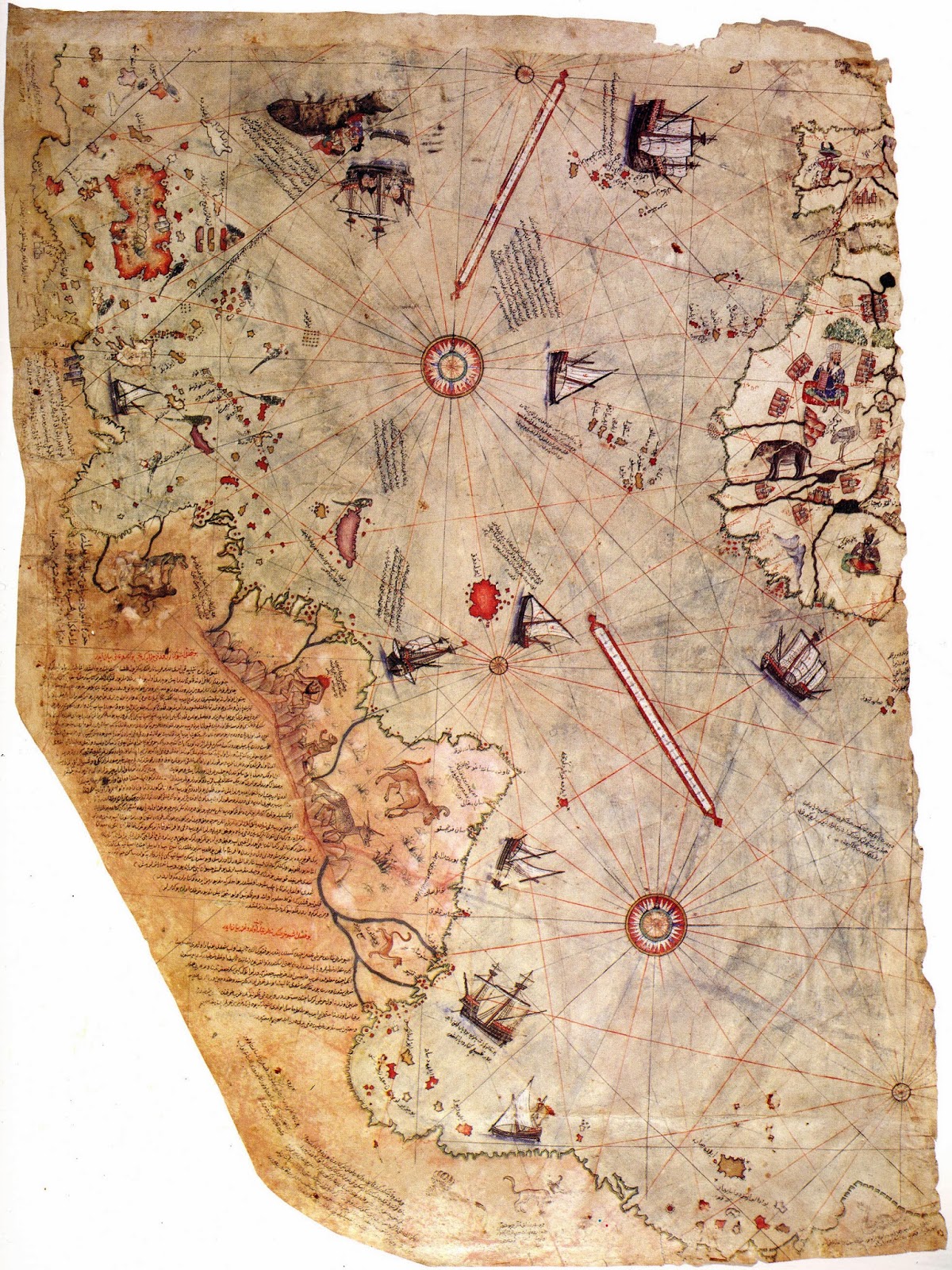
If Charles Hapgood was right about the Piri Reis map, his findings beg a series of questions. Who in the ancient world would've been capable of mapping out the entire globe with such accuracy? What became of this civilization and where are its remnants? And lastly, what could possibly erase nearly all traces of these enigmatic people?

In his dialogues Timaeus and Critias written in 360 BCE, Plato offers the first clue. He tells us that the powerful empire of Atlantis, which controlled many parts of Europe and Africa at the height of its power, succumbed to a terrible cataclysm and sank beneath the waves around 9,600 BCE.

Without corroborative testimony from independent sources Plato's account carries little weight, but what happens when a bunch of myths line up? What are we to think when the legends of various peoples corroborate each other?

Few scholars give credence to the Biblical story of Noah's Ark. A global flood like the one described in Genesis, geologists argue, would leave a distinct mark on our planet and so far this mark hasn't been found. But what if the flood described Genesis is a primitive person's interpretation of real events? What if different parts of the world suffered different calamities? Those who witnessed the upheaval of the seas would describe it as a divinely-inspired flood while those who experienced volcanic eruptions might describe a time of darkness or burning skies or whatever.

Noah's story in Genesis isn't the oldest account of a species-ending flood. That distinction belongs to the Epic of Gilgamesh. Penned in 2,800 BCE, this literary work contains what is likely the "original"  flood narrative of the Middle-East. Its influence on other myths can easily be traced along the unbroken chain of culture from Mesopotamia--the cradle of civilization--to Egypt, Greece, Rome, and then Europe. That flood stories are found among these people, the inheritors of Mesopotamian culture, is unsurprising.

What is surprising is the abundance of flood stories in pre-Colombus America. The Maya, Inca, Aztec, and various Native-American tribes all possessed flood myths long before the Europeans showed up. In fact, European explorers were shocked to find these accounts already well-established among the "savages" and took this as proof of the Bible's authenticity.

Scumbag Nephilim ruining it for the rest of us
Old world and new world flood narratives share more in common than a simple cataclysm. For instance, the author of Genesis claims that giants roamed the earth before the flood; so does the legend of Viracocha in Peru. In the Egyptian flood story, Osiris comes after the waters abate to spread knowledge and civilization to the survivors; in Mexico, the role of civilizer after the time of darkness is filled by Quetzacoatl, the Plumed Serpent.

Remember: these civilizations are separated by a vast ocean. There is no possibility for cross-contamination here.

I don't believe that God flooded our planet as punishment for our misbehaviour. All I'm saying is there are too many similarities between the stories to claim coincidence. Myths and legends, no matter how fantastical, are based to some degree on reality. When dozens of myths and legends across the world tell roughly the same story with many of the same detail one cannot help but wonder whether there is a basis for these stories in reality.

That's what Charles Hapgood wanted to know. He tried to imagine what might cause a global catastrophe of massive proportions. In his research he stumbled onto the work of Hugh Auchincloss Brown (1879-1975), an electrical engineer who proposed that the weight of the ice at the poles might cause the tipping of the earth's axis at regular intervals.

Hapgood took Brown's theory and elaborated. What if the weight of the ice caused the earth's rigid outer crust to shift across the soft inner core while remaining mostly intact? Don't confuse this with plate tectonics or continental drift, both of which operate on a massive timeline. Hapgood proposed that the entire outer layer of the earth's crust--the one containing all the plates, oceans, and continents--might be forced to slide suddenly--not over millions of years--into a new position while leaving the axis of the planet unchanged. One can imagine the effects such a movement would have on the oceans, not to mention seismic and volcanic activity worldwide.

Hapgood's crustal displacement theory connects a lot of dots. It explains how a civilization might've dwelt in Antarctica before a crustal displacement shifted the continent further south and transformed the region into a frozen wasteland. It explains how deluge myths appear in nearly every culture on the planet. It explains other curious findings like the preserved mammoths found in Siberia who appear to have been flash-frozen while grazing, or the temperate vegetation beneath the ice-sheets of Greenland. 

Einstein found crustal displacement theory plausible but he argued that the weight of the ice built up at the poles wouldn't suffice to shift the outer crust. Something else was required in order to make the outer crust budge.

Roughly 12,900 years ago in North America, 35 species including the mammoth, that noble beast, and the Clovis culture who hunted them were suddenly wiped out. Scientists have been looking for an explanation for a while and last year they found nanodiamonds in the sediments of this time period at six different sites. Can anyone tell me what might have created these nanodiamonds?

Massive pressure and unbelievable heat. In other words, a big fucking explosion. Scientists suspect a comet larger than the one presumed to have hit Siberia in the early 1900's.

Could the impact have caused the earth's crust to shift? Or did the comet alone cause the cataclysm which lives on in the flood narratives of our ancestors? Either way, it's tough to deny something big must've happened.


I'll leave you with the story of a Russian botanist named Nikolai Vavilov. Vavilov identified eight centres of origin--places where the practice of agriculture suddenly and inexplicably sprang up at the start of the Neolithic Revolution--and guess what he found when he put these locations on a map? They coincide with the eight highest elevations on earth.

Like I said before, too many coincidences. 

Friday, February 7, 2014

For Every Hubble, a Dozen Hapgoods

New ideas are almost always met with resistance, especially when they threaten to uproot the deeply-held beliefs of others. Theories which are widely accepted as fact today were greeted with denial and hostility when first proposed. Copernicus, Darwin, Galileo, Kepler, and Hubble all faced resistance. The lucky ones lived to see their ideas vindicated; the unlucky ones were persecuted, ridiculed, or shunned.

Scholars who practice the "hard sciences"--math, physics, chemistry, etc.--are more likely to overcome the resistance of their peers because they operate within a shared paradigm. They agree on a set of basic rules which provide a means for testing hypotheses. Hubble was able to convince his peers that nebulae are distant galaxies by using a set of laws which were verifiable to anyone who understood them.

But what about history, anthropology, philosophy, sociology, archaeology, and the other soft sciences? These disciplines depend on subjective methods and interpretations. Take history, for example. When a historian comes across a radical new theory he cannot test it via some objective method. He must look at the historical records and see if his new theory fits where it should. Never mind that historical accounts are penned by humans, the most notorious liars on the planet. If the new theory doesn't fit then it is discarded without further consideration.

This leaves us in a predicament. How are we to test the validity of existing models if all ideas that question their validity are rejected without genuine consideration?

For every Edwin Hubble there are dozens of scholars whose theories never see the light of day or whose otherwise successful careers are destroyed because they dared suggest something unorthodox.

Charles Hapgood is such a scholar.

Hapgood was a well-respected academic. He earned his masters in history, worked for what would become the CIA, and went on to teach extensively at various colleges. He enjoyed regular correspondence with Albert Einstein, who penned the foreword to one of Hapgood's books.

Hapgood's theory goes as follows. There existed in prehistory a civilization advanced enough to map the entire globe with extreme accuracy; this civilization was located in Antarctica which was either completely or partially ice-free at the time; a cataclysm destroyed this civilization; a few survivors escaped with their lives, scattering to the Americas and Africa where they proceeded to educate the local hunter-gatherers in matters of agriculture, engineering, writing, and metallurgy.

He didn't come straight out with all of this right away. His theory came together piecemeal, one discovery at a time, starting with the enigmatic Piri Reis map.


Compiled in 1513 by a Turkish admiral named Piri Reis, the map appears to chart the northern coast of Antarctica, a landmass which was only discovered in the 1800's. Thinking he had misread the map, Hapgood sent his findings to the U.S. Airforce. Hapgood received the following response:
Your request for evaluation of certain unusual features of the Piri Reis World Map of 1513 by this organization has been reviewed. 
The claim that the lower part of the map portrays the Princess Martha Coast of Queen Maud Land Antarctic, and the Palmer Peninsula is reasonable. We find that this is the most logical and in all probability the correct interpretation of the map. 
The geographical detail shown in the lower part of the map agrees very remarkably with the results of the Seismic profile made across the top of the ice cap by the Swedish-British-Norwegian Antarctic Expedition of 1949. 
This indicates the coastline had been mapped before it was covered by the ice-cap.
The ice-cap in this region is now about a mile thick. We have no idea how the data on this map can be reconciled with the supposed state of geographical knowledge in 1513.
A second response followed shortly after. This one came from the chief cartographer of the 8th Reconnaissance Technical Squadron and further supported the original reply:
...Antarctica appears to be truly represented on the southern sector of the Piri Reis map. The agreement of the Piri Reis Map with the seismic profile of this area made by the Norwegian-British-Swedish Expedition of 1949 [...] places beyond a reasonable doubt the conclusion that the original source maps must have been made before the present Antarctic ice cap covered the Queen Maud Land coasts.
And of course:
We are convinced that the findings made by you and your associates are valid, and that they raise extremely important questions affecting geology and ancient history, questions which certainly require further investigation.
Here then is a genuine mystery which, according to the chief cartographer of the 8th Reconnaissance, requires "further investigation." Was such an investigation ever conducted in earnest? Of course not. Mainstream historians scoffed at the idea. No civilization prior to the modern era possessed the know-how to map the globe, let alone outline the Antarctic coast beneath a hundred feet of ice.

Rather than re-evaluate the current narrative, mainstream scholars chose to ignore Hapgood's findings. They proclaimed that the Piri Reis map had been misread by Hapgood and his friends in the 8th Reconnaissance. They gave the theory no consideration. Hapgood was left to continue his search on the fringes, without the support of the academic world.

No matter. Hapgood's work was only beginning. What he proposed next is terrifying and plausible and could explain how an advanced people were pushed to near-extinction. It could explain how portions of Antarctica were ice-free between 13,000-4,000 BCE and also what caused the sudden change in temperature.

Best of all, Hapgood's second contribution receives a glowing endorsement from Albert Einstein himself, who says that Hapgood's "idea is original, of great simplicity, and–if it continues to prove itself–of great importance to everything that is related to the history of the earth’s surface."

BOME. To be continued...

Monday, January 27, 2014

Göbekli Tepe and the Mystery of History

In my homage to Edwin Hubble I spoke of world-shattering discoveries that force us to rewrite previously established notions we have about reality. Hubble’s discovery—that nebulae were actually other galaxies far beyond our own Milky Way--persuaded astronomers to scrap the “island-universe” model we previously employed in favor of the “big fuckin’ universe” model we currently hold.

Recent archeological findings in Turkey could do to our model of human history what Hubble’s discovery did to the “island-universe” theory back in 1934. The idea that the oldest civilizations on earth date back to no later than 6,000 BCE could be seriously damaged by these new discoveries, opening the door to a variety of fringe theories which have, until now, been treated with scorn or dismissed out of hand by mainstream academics.

The consensus is that humans came on the scene around 2 million years ago in Africa. They eventually wandered out of the Olduvai Gorge in small groups of hunter-gatherers and spread out across Europe, the Middle-East, and Asia before crossing the Bering Strait to the Americas.


The hunter-gatherer lifestyle isn't conducive to technological advancement so for the bulk of our 2 million year existence human innovation consisted of mastering fire and simple tool-making. Then, around 12,000 years ago, people discovered agriculture and animal husbandry, kicking off the Neolithic Revolution and the dawn of sedentary life.

This is how human civilisation was born.

According to this narrative the first cities arose in the Fertile Crescent around 6,000 BCE. The Bronze Age started around 4,000 BCE, bringing with it knowledge of metallurgy and writing as well as the establishment of trade routes in the Near East. Phase one of Stonehenge was finished around 3,100 BCE, the Great Pyramid was completed on 2,560 BCE, and work on the Great Wall of China was underway in 700 BCE.

This narrative implies that the appearance and advancement of civilisation is only possible after agriculture arrives on the scene. Before the Neolithic Revolution, people were too busy chasing their next meal and surviving the elements to start experimenting with metallurgy, masonry, or large-scale construction.  Being scattered across the globe in small groups, humans could never mobilise a workforce large enough to build the megaliths of ancient times.

Enter Göbekli Tepe.

Sitting atop a mountain ridge in Turkey, the site was discovered in the 1960's and left untouched until 1994 when a team of German archaeologists led by Klaus Schmidt started digging down into the hill. According to one Stanford professor, what these archaeologists found "changes everything."

The oldest part of Gobekli Tepe consists of T-shaped stone pillars arranged in a circle. Each pillar measures twenty feet in height and weighs 20 tons. There are more than 200 pillars arranged in about 20 circles and each pillar is fitted into sockets that were hewn out of the bedrock. The second and newest phase consists of smaller pillars set in rectangular rooms furbished with polished lime floors.

Now Gobekli Tepe isn't unique or unrivalled in terms of size, scope, or engineering. In fact it is comparable to Stonehenge, whose outer circle uses stones which are slightly larger than those used in Gobekli Tepe's first phase.

The thing that makes Gobekli Tepe stand out is its age. According to radiocarbon dating, the oldest portion is in the neighbourhood of 12,000 years old.

That's roughly 4,000 years before the first human settlements appear on the scene. That's before metal tools or wheels or domesticated horses. How Göbekli Tepe's builders amassed a workforce, cut the stones in the nearby quarry, hauled them uphill, and arranged them in a circle, is a mystery. 

Göbekli Tepe's purpose is also a mystery, though slightly less so.

Excavations have revealed little proof of permanent habitation. A variety of animals, some local, some exotic, were carved onto the pillars. The workmanship is impressive too, especially considering they lacked experience in stone working and possessed only flint tools.

Another clue is the presence of butchered animal bones, present in large numbers at the site.

Schmidt believes Göbekli Tepe was a stone-age mountain sanctuary, a site of ritualistic, spiritual, or maybe even religious importance. It may have served as an annual meeting place for local groups of hunter-gatherers, a place for them to celebrate some forgotten holiday.

In order to make sense of Göbekli Tepe scholars will have to review the accepted chronology of human existence. In doing so, I hope they take a second-look at some of the other theories they rejected on the basis of the Neolithic Revolution. The notion that humans were incapable of advanced construction before the appearance of sedentary civilisations is clearly wrong; Göbekli Tepe proves that.

Either our prehistoric ancestors were more advanced and resourceful than we thought, or else we must look for alternate means of explaining Göbekli Tepe. No, I don't subscribe to the ancient astronaut theory but I think the idea of a lost civilisation merits further inquiry.

The concept may sound fantastical but it actually isn't that far-fetched.

Look at the current state of our species. Smartphones, solar power, jets, space-flight, hydrogen bombs, the Large Haldron Collider: we achieved this level of technology in a mere 12,000 year period. How many times might we have achieved similar levels sophistication in the past 200,000 years?

All it takes is a well-placed asteroid or global catastrophe, the near-extinction of our species, and 30,000 years for Mother Earth to bury the evidence. The lucky survivors would revert back to primitive life in a few generations, carrying with them tales of this prehistoric doomsday in the form of myths and legends.

I won't plead my case for the "False Start Hypothesis" here as it merits its own post. Consider this a primer. Like Hubble's discovery, Gobleki Tepe forces us to question notions we accepted as truth. There's more to prehistory than we know, just like there's more to the universe than our Milky Way.

The more we learn, the more we realise we don't know a whole lot. We've got records going back 6,000 years but we've been around for hundreds of thousands of years. Think of human history as a puzzle. Gobekli Tepe is the missing piece we didn't know existed. Fitting it into the puzzle will require us to take other pieces out, rearranging them if we can, discarding them if we can't.

How many more such pieces are scattered across the globe, waiting to be discovered? And what will human history look like once we find more of them?

I get excited just thinking about!

Friday, January 10, 2014

Edwin Hubble


Circling earth's orbit, the Hubble Space Telescope is humanity's unblinking eye to the cosmos. It allows us to peer deep into the universe to the very dawn of time and helps us resolve long-standing problems in astronomy. It also helped confirm several theories put forth by the man after whom the telescope is named, Edwin P. Hubble.

Every once in a while a person puts forth a theory that requires us to rewrite our accepted model of the cosmos. Edwin Hubble was such a person. He made several important discoveries during his career but one in particular stands out to me as the most mind-blowing of all. It's this discovery which forced astronomers to rethink their view of the universe in a radical way.

Allow me to set the scene.

"You lookin' to party tonight, honey?"
The year is 1922. The place is Mount Wilson, California, site of the poorly-named Hooker Telescope, the world's most powerful device of its kind. At the helm of this sits Edwin Powell Hubble, a 33 year-old astronomer only five years removed from college.

Edwin wanted to be a professional astronomer since boyhood but, being a dutiful son, he fulfilled his father’s wishes and studied law instead. He was at Oxford University doing just that when he received word that his father had passed away. Upon returning home to take care of his mother, Edwin, then 25, decided to abandon law and pursue his dream. He received his PhD in 1917 after publishing his dissertation, “Photographic Investigation of Faint Nebulae,” and became an astronomer. 

In order to fully appreciate Hubble’s discovery we must first talk about the model of the universe at the time. You see back then, astronomers believed that the Milky Way galaxy was a so-called "island universe,” an island of matter surrounded by the infinite void of space.

With their pre-Hooker telescopes, astronomers observed two different types of celestial bodies: stars and faint, nebulous shapes which they called nebulae. No one knew exactly what nebulae were. The prevailing theory was that they were oddly-shaped clouds of gas or diffuse stars. They named them according to shape. The Spiral Nebula, the Eagle Nebula, and so on. It was assumed that both stars and nebulae were part of the Milky Way.

Equipped with the state-of-the-art Hooker telescope, Edwin got an unprecedented view of the heavens. As you probably guessed from the title of his dissertation, nebulae were of particular interest to him. What he discovered about them was world-shattering. According to Hubble’s calculations, the nebulae were hundreds, thousands, and in some cases millions of light-years away. 

In other words, nebulae could not be located within the Milky Way. 

But where else? If the Milky Way formed the entire universe, how could nebulae exist beyond its borders? Imagine Hubble's reaction as it dawned on him. Nebulae were not clouds of gas or diffuse stars as had been previously thought: they were other galaxies, like the Milky Way, only millions of light years removed, scattered across the heavens, and too numerous to count.

Put yourself in his shoes for a moment. Edwin Hubble’s universe went from being the size of the Milky Way—200 billion stars deep and nothing to scoff at—to the size of billions of Milky Ways separated by countless light-years of empty space.

It’s no surprise that Hubble’s conclusion was met with scorn or dismissed out of hand; even today people have a tough time wrapping their heads around the size and scope of the universe. If our puny minds can barely handle the scope of the universe now, imagine what people in the 1930’s thought! 

Our understanding of the universe has come a long way. We started out on a flat-earth located at the centre of all creation, then progressed to a round earth. A while later Copernicus had the gall to propose that the sun—not the earth—was at the center of the universe, which was only partially right. Finally we thought the Milky Way formed the entire universe; now we know it’s just a grain of sand, a speck of galactic dust among billions.

Whenever we think we have a handle on things someone like Edwin Hubble comes along and blows our understanding out of the water. For every difficult question we answer, we expose more questions. Hubble expanded the borders of our universe beyond the Milky Way; could future discoveries expand the universe even further? Could ours be one of many universes? 

If we learn anything from Hubble and all the other radical thinkers who dared disrupt the prevailing theories of their time, it’s that we don’t know much and what we do know is subject to change drastically and with little warning. 

We may never fully understand the nature of the universe, reality, human consciousness, etc. All we can ever hope for, to paraphrase Carl Sagan, is an ever-improving understanding, not a perfect one. 

Edwin Hubble’s contributions helped advance human understanding one huge step forward.

Thanks Ed!